Single Glass PERC Solar Panel for Rooftop Installation: The 2026 Installer's Complete Guide

Mr. Xiao — Senior Solar Sourcing Specialist
Hubei Xinjie New Energy Technology Co., Ltd. | 15+ Years in PV Supply Chain | Wuhan, China
📋 Table of Contents
[ Toggle ]Why the Panel You Choose Changes Everything on a Residential Roof
Dimensions, Wattage, and Fit: Getting the Numbers Right for Residential Rooftops
Why Single Glass PERC Is Still the Right Call for Most Rooftop Installations
Rooftop Solar Regulations in Europe and Australia: What Installers Need to Know in 2026
Technical Specifications: How to Read a PERC Single Glass Datasheet for Rooftop Use
Sourcing PERC Single Glass Rooftop Panels from Xinjie: What We Offer Installers
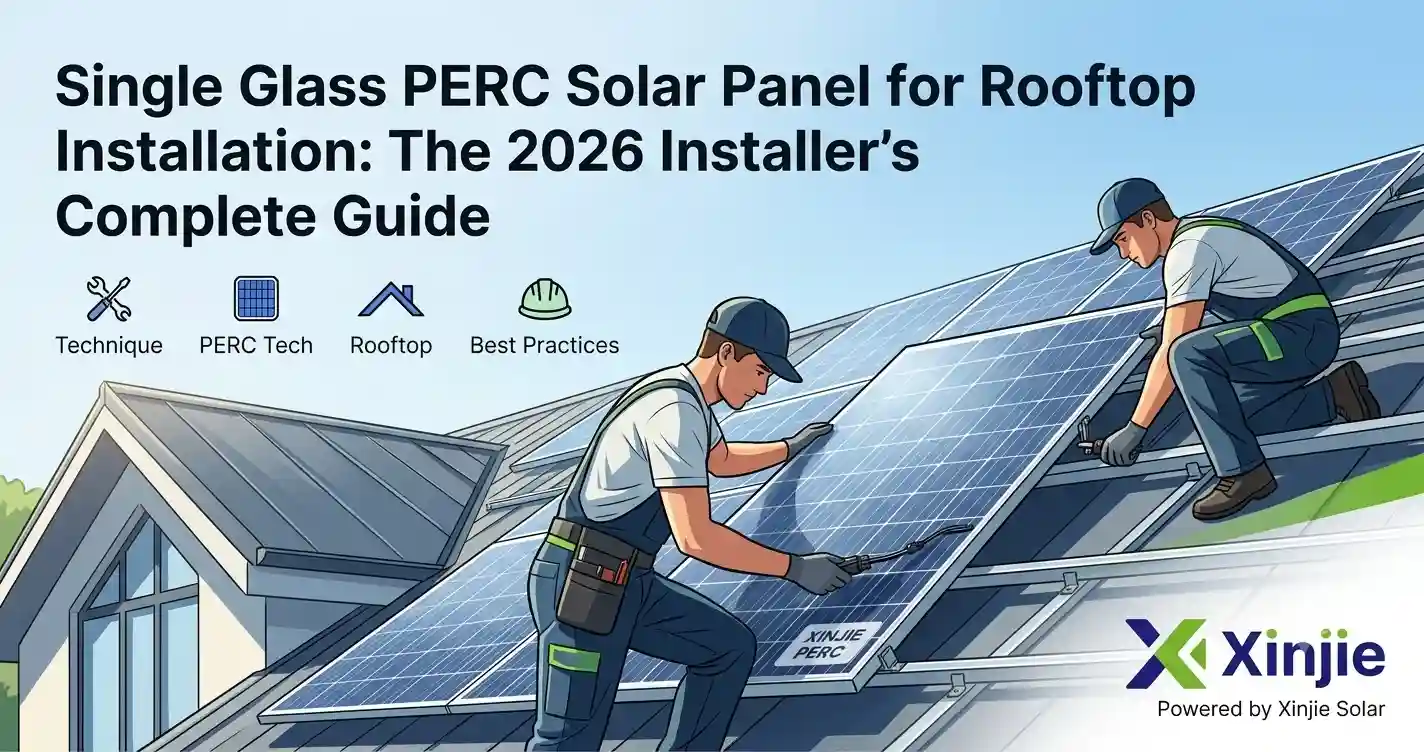
Why the Panel You Choose Changes Everything on a Residential Roof
Here is a situation I run into with surprising frequency. An installer contacts me after they have already committed to a supplier. They ordered a batch of large-format commercial panels — 580W or 600W modules — because the per-watt price looked attractive. Then the panels arrived, the installation crew showed up at the job site, and the problems started.
The panels were over 2.2 metres tall. The roof was a standard European pitched tile roof, not a flat commercial warehouse. Getting a panel that long up a ladder and into position without damaging it — or the tile — requires a different set of hands, different equipment, and significantly more time per panel. On a 12-panel residential job, that extra handling time adds hours. Hours turn into labour cost. The per-watt saving on the panels evaporated before lunch on the first installation day.
I am not telling that story to be cautionary in a patronising way. I am telling it because the decision between a residential-format single glass PERC panel and a larger commercial module is one of the most consequential specification choices an installer can make — and it is often treated as an afterthought. Panel weight, physical dimensions, roof structural capacity, local building regulations, and mounting system compatibility all intersect in ways that are invisible in a catalogue PDF but immediately obvious when you are on a rooftop.
This guide is written for solar installers and system integrators working primarily in Europe and Australia — two markets where residential rooftop solar is growing rapidly, where building codes are specific, and where customers are increasingly knowledgeable about what they are buying. I want to give you a clear, technically grounded picture of why single glass PERC in a residential 400W format remains the smart default for most of the jobs you will encounter in 2026, and how to source it from a supplier — like Xinjie — who understands what the product actually needs to do once it leaves the factory.
The Weight Question: What Your Roof Can Actually Hold
Weight is the single most misunderstood dimension of rooftop panel selection. Most installers know that weight matters — but very few know the actual numbers they are working with until they run into a structural constraint on a specific job.
Let me give you the reference framework that I use when advising buyers on residential installations.
What a Standard Residential Roof Can Bear
Rooftop solar structural assessments typically evaluate roof load capacity at 15–25 kg/m² for panels plus mounting. That range accounts for the combined dead load of the panel itself, the aluminium rail system, the clamps, and the wiring. It does not account for live loads — maintenance workers walking on the roof, snow accumulation in northern European climates, or sustained wind pressure in coastal Australian conditions. Those factors layer on top of the panel dead load and must be assessed separately.
Fortunately, most home roofs can comfortably withstand the weight of a solar panel array — a typical residential array will weigh well below the average roof's weight-bearing capacity. But "comfortably" is a statistical average, not a guarantee that applies to every building. Older European homes — particularly pre-1970s construction in Germany, Poland, or the UK — and some Australian homes with lightweight metal roofing on older timber trusses may have structural capacity limitations that require an engineer's assessment before installation proceeds.
Single Glass vs. Dual Glass: The Weight Difference Matters
This is where single glass PERC has a genuine, practical advantage over its dual glass counterpart for residential rooftop applications. Real-world weights vary based on the manufacturer and design of the panel — the estimated weight falls between 17kg to 28kg. More specifically:
Standard single glass PERC (400–440W residential format):
Each panel weighs 18–22 kg and is 35–40 mm thick.
Dual glass / bifacial modules (same wattage class): Typically 24–28 kg due to the second glass layer replacing the polymer backsheet.
Large-format commercial modules (500W+):
These are heavier, harder to handle on pitched roofs, and may exceed the structural load rating of your roof framing.
On a 20-panel residential system, the difference between an 18kg single glass panel and a 26kg dual glass module is 160kg of total additional dead load on the roof structure. On a sound modern roof, that difference is manageable. On a building where the structural assessment is already marginal, it can be the deciding factor between a standard installation and a costly structural reinforcement project.
Rooftop solar panels typically weigh around 20kg each, with most Australian residential models ranging from 18kg–25kg. This weight is well within the limits of compliant roofs, but installers still assess total loading, including rails and clamps.
💡 Mr. Xiao's Structural Check Rule
Before specifying panels for any residential job, confirm three things: (1) the roof framing type — prefabricated trusses, solid sawn rafters, and engineered I-joists each have very different load capacity profiles; (2) the age and condition of the roof covering — a tile roof that is already showing sag or displacement is a warning sign before panels go anywhere near it; (3) your local building authority's current structural assessment requirements, which in many European and Australian jurisdictions changed in 2024–2026. A site survey that skips structural verification is not a complete site survey.
Dimensions, Wattage, and Fit: Getting the Numbers Right for Residential Rooftops
The shift toward larger-format high-power modules has created a real tension in the residential market. In 2026, the industry has shifted toward larger, high-efficiency cells (M10 and G12), making old "standard" measurements obsolete. Today, solar panels are generally categorized into two sizes: Residential (easier to handle on sloped roofs) and Commercial/Utility (larger, heavier, and higher output).
For a residential installer, the practical implication is this: not every module on the market belongs on a residential roof, regardless of how attractive the watt price looks in a supplier's catalogue.
The Residential-Format Standard in 2026
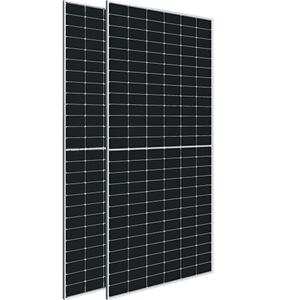
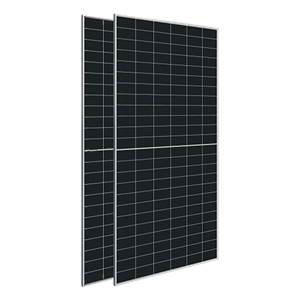
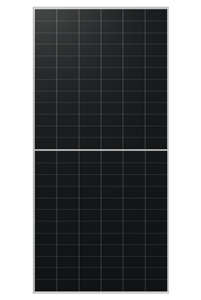
The most common residential solar panel in Australia in 2026 is rated between 400W and 440W. These panels use 144 half-cut monocrystalline cells arranged in a rectangular frame. The typical dimensions are approximately 1,722 × 1,134 × 30mm, weighing 20–22kg — roughly 1.7 metres tall, 1.1 metres wide, and 3 centimetres thick.
In the European market, the standard residential format is broadly similar: a dimension spec of a solar panel, for example, might be 1,722mm × 1,134mm, with an output rating of 400W, 20.5% efficiency, and 21kg weight. These figures are representative, not universal — different manufacturers within the residential format class will have slight variations.
The key characteristic of a residential-format panel is that it is designed to be manually handled and positioned on a sloped pitched roof by a two-person crew without crane assistance. While commercial panels offer more "watts per module," they are notoriously difficult to install on residential roofs due to their length (over 2.2 meters) and the wind load they create.
How Many Panels Fit on a Residential Roof?
For a 2026 install, the rule of thumb is 1 kW of solar per ~70 sq ft of total roof area, or about 28 sq ft of total roof per modern 400W panel. Most local building codes require a 1-metre (3ft) walkway around the edges of the roof for firefighter access, and you will also need to account for setbacks around chimneys, skylights, and vent penetrations.
For a standard European or Australian residential roof, a 6.6kW system requires approximately 15–17 panels in the 400W class. A standard 6.6kW system needs roughly 30m² of usable roof area. That is a practical number for the majority of single-family homes — accessible without structural modifications and well within the load capacity of a compliant modern roof.
| Specification | Residential PERC SG (400–440W) | Commercial Module (500W+) |
|---|---|---|
| Typical Dimensions | ~1,722 × 1,134 mm | >2,200 × 1,134 mm |
| Weight (Single Glass) | 18–22 kg | 24–30 kg |
| 2-Person Manual Install on Pitched Roof | ✅ Standard practice | ⚠️ Difficult / risky |
| Wind Load on Sloped Roof | ✅ Within standard calculations | ⚠️ Higher — may need racking upgrade |
| Standard Racking Compatibility | ✅ Universal | ⚠️ Requires verification |
| Suited to Pitched Tile / Metal Roofs | ✅ Designed for this | ❌ Designed for flat commercial |
| Crew Size Required | 2 people | 3+ people or lifting equipment |
Half-Cut Cells: Why It Is Now the Default for Residential
Nearly all panels sold in 2026 use half-cut cells. This means each silicon cell is cut in half during manufacturing, doubling the cell count without changing the external dimensions. The benefit is performance, not size — half-cut cells carry lower current per cell, which reduces resistive losses and improves output in partial shade. If one row of cells is shaded, only that section is affected rather than the whole panel. You do not need to worry about choosing between half-cut and full-size — if you are buying a new panel in 2026, it will almost certainly be half-cut already.
For rooftop installers working on homes with chimneys, dormers, or neighbouring building shading, this matters practically. A half-cut cell residential PERC panel handles partial shade conditions significantly better than an older full-cell design, which means fewer performance complaints from homeowners after installation.
Why Single Glass PERC Is Still the Right Call for Most Rooftop Installations
I want to address the question directly because it is one I get regularly from installers who are being pitched on bifacial dual glass modules as a universal upgrade: is single glass PERC still worth specifying in 2026, or should everything go bifacial?
The honest answer requires understanding what bifacial gain actually requires. Bifacial panels are typically ground-mounted — not rooftop-mounted — because roofs do not provide reflective surfaces beneath the panels. On the ground, snow, sand, or light-coloured gravel can reflect sunlight back onto the rear face. Bifacial panels cost more than standard panels. For a rooftop installation, they do not provide any advantage since your roof is dark and does not reflect light.
This is not a theoretical concern — it is a direct economic argument. Specifying a dual glass bifacial panel for a standard residential pitched roof means your customer pays a 10–15% premium for a module feature they will never use. The rear glass adds weight. It adds cost. It provides no bifacial generation benefit whatsoever in the installation environment. From a professional installer's perspective, it is the wrong product for the application.
Single glass PERC on a residential roof, on the other hand, is exactly the right product. Here is why:
Weight advantage:
The typical dimensions are 1.7m tall × 1.0m wide (including the aluminium frame). Each panel weighs 18–22 kg and is 35–40 mm thick. The power output ranges from 300W to 420W, ideal for smaller roofs.
Technology maturity:
PERC technology is now mature and widely proven in the field. Twelve years of real-world rooftop performance data exist. Failure mode patterns are understood. Warranty claims are well-documented. For customers and installers who value predictability, that maturity is genuinely valuable.
Efficiency for the application:
If you have plenty of roof space and a normal climate, standard PERC panels deliver excellent value. For a standard European or Australian home with adequate roof area, mono PERC single glass in the 400–440W class delivers more than enough output at a price that makes system payback calculations comfortable for the homeowner.
Cost efficiency for the installer:
PERC panels remain a solid choice when price-per-watt is the primary constraint. You are trading some long-term yield for lower upfront cost — best suited for larger-area roof installations where space is not limiting.
There are scenarios where N-type TOPCon makes sense even on a residential roof — specifically where roof space is genuinely constrained, where the homeowner wants the maximum output from a limited footprint, or where the local feed-in tariff structure strongly rewards maximising generation. One percentage point of efficiency gain translates to roughly 4 fewer panels on a 10 kW system, or the same output from 2 fewer square meters of roof area. If every square metre of roof counts, pay for the efficiency premium. But if the roof has adequate space, single glass PERC delivers the same outcome at a lower system cost — and that is what makes the total installed price competitive for your customer.
💡 The Efficiency vs. Space Trade-off — Mr. Xiao's Simple Rule
I tell installers: if the roof can physically fit enough 400W PERC panels to meet the customer's kWh target with 20% margin to spare, stay with single glass PERC. Only upgrade to N-type if the usable roof area genuinely constrains output, or if the project requires bankable performance warranties from a financier. Paying a 15–20% per-watt premium for efficiency gains you do not need is not good value engineering — it is just upselling.
Rooftop Solar Regulations in Europe and Australia: What Installers Need to Know in 2026
The regulatory landscape for residential rooftop solar in both Europe and Australia has evolved significantly, and some of the changes directly affect which panels you can legally specify and how you install them.
European Union — EPBD Solar Mandate
The EU's revised Energy Performance of Buildings Directive (EPBD) now mandates solar energy installations on different categories of buildings. The directive requires that all new buildings are designed to optimise their solar energy generation. The rule applies to buildings for which the building permit application is made after 29 May 2026, ensuring that suitable solar installations can be added in the future without costly structural changes — and a key design factor is supporting the additional weight of solar installations.
In practical terms, this means new residential construction in the EU is being designed with panel weight as a structural input from the planning stage. For installers specifying panels on existing older housing stock, however, the structural assessment burden falls on the installation team. Aspects such as the technical and economic potential of solar energy installations on specific buildings, and the structural capacity of a building to bear additional weight, should be taken into account.
The certification requirement across the EU remains CE marking, with TUV IEC 61215:2021 certification providing the technical performance standard. Germany specifically requires DIN EN 1991 compliance for structural load calculations, and any installation that modifies the load path requires a Statiker (structural engineer) sign-off.
United Kingdom — UKCA Post-Brexit
The UK separated from EU CE marking requirements and now operates under the UKCA (UK Conformity Assessed) framework for solar panels sold into the British market. This is one of the certifications Xinjie holds directly — which makes us one of relatively few Chinese suppliers who can supply panels into the UK residential market without the installer needing to source a UKCA-compliant certificate independently. UK installs require a structural calculation when the roof is assessed as potentially marginal, which the installer or a chartered engineer documents.
Australia — AS/NZS Standards
Australia operates under AS/NZS 1170 for wind and snow loads, with AS/NZS 5033 for the electrical installation side. Australian residential installations must use Clean Energy Council (CEC) approved products and accredited installers to qualify for the Small-scale Renewable Energy Scheme (SRES) incentives. The CEC approved products list is a critical compliance checkpoint that installers need to verify before specifying any panel from a new supplier.
For typical Australian homes, rigid framed panels with known, tested dimensions and weights that suit permanent rooftop mounting and local standards are the appropriate choice — and while many online guides stop at listing numbers, the practical application requires translating those figures into a proper roof design for your specific property.
| Market | Key Certification Required | Structural Standard | Xinjie Certification Status |
|---|---|---|---|
| European Union | CE + TUV IEC 61215:2021 | Eurocode EN 1991 | ✅ CE + TUV SUD + TUV Nord |
| Germany | CE + TUV + Statiker sign-off | DIN EN 1991 | ✅ TUV Dynamic Mechanical Load certified |
| United Kingdom | UKCA + TUV | BS EN 1990/1991 | ✅ UKCA certified (held directly) |
| Australia | CEC Approved Products + IEC 61215 | AS/NZS 1170 + AS/NZS 5033 | ✅ TUV + Intertek (CEC verification advised) |
⚠️ UKCA vs. CE: A Critical Distinction for UK Installers
A panel with CE certification alone is not sufficient for UK residential installation under the post-Brexit UKCA regime. The two marks coexist for some product categories, but for solar panels entering the UK market specifically, the UKCA mark is the operative compliance requirement. Many Chinese suppliers have CE certificates but no UKCA — because getting UKCA requires separate UK conformity assessment through an approved body. When you request samples from any new supplier for UK projects, ask specifically: "Do you hold a current UKCA certificate, and can you verify it with the issuing body's reference number?" If the answer is anything other than a direct yes with a certificate number, factor that compliance risk into your decision.
Technical Specifications: How to Read a PERC Single Glass Datasheet for Rooftop Use
When you receive a product datasheet from a supplier, the headline efficiency and wattage numbers get all the attention. But for a rooftop installation context, five other specifications matter just as much — and are rarely discussed in supplier presentations.
| Datasheet Parameter | What to Look For | Why It Matters for Rooftop Install |
|---|---|---|
| Module Weight | Target 18–22 kg for residential | Directly affects roof structural load and crew handling safety |
| Dimensions (L × W × H) | Max ~1,722 × 1,134 × 40mm for residential | Panels >2,100mm length become unmanageable on pitched roofs |
| Temperature Coefficient (Pmax) | PERC: -0.35 to -0.40%/°C | Determines real summer output — critical for customer performance expectations |
| Maximum Wind Load | Minimum 2,400 Pa front / 2,400 Pa rear | European and Australian coastal/alpine sites experience high wind; verify against local AS/NZS 1170 or Eurocode wind zones |
| Maximum Snow Load | Minimum 5,400 Pa for Northern Europe | Required for German / Scandinavian / Alpine market compliance |
| Annual Degradation Rate | PERC: 0.45–0.55%/yr; Year 1: ≤2% | Directly determines the 25-year energy yield guarantee for your customer |
| Power Tolerance | Look for 0/+5W or better (positive tolerance) | Negative tolerance means panels deliver less than labelled — unacceptable for a customer who pays per watt |
The Temperature Coefficient Conversation
This is the parameter I find most often glossed over in residential sales presentations, and it is the one that causes the most customer dissatisfaction when expectations are not managed correctly. TOPCon panels lose about 0.29–0.32%/°C, and older PERC panels lose 0.35–0.40%/°C. On a 65°C panel surface in summer heat, you might see 15–20% power loss compared to the nameplate rating.
For a homeowner in Southern Europe or Western Australia, where panel surface temperatures regularly reach 65–70°C on summer afternoons, this means their 415W PERC panel is actually producing around 340–355W during peak afternoon hours. That is not a malfunction or a defective panel — it is normal thermodynamic behaviour. But if the installer has not explained this to the customer, that homeowner is looking at a monitoring app and wondering why their "415W panel" is only showing 340W at 2pm in July.
Set the expectation correctly at the time of system design and installation handover. The annual energy yield model — factored with temperature coefficient losses and local irradiance data — is the number that matters, not the STC nameplate.
Sourcing PERC Single Glass Rooftop Panels from Xinjie: What We Offer Installers
I want to be specific about what Xinjie offers residential installers and system integrators who are sourcing PERC single glass panels for the European and Australian markets — because our offer is not identical to a generic trading company's catalogue, and I think the differences are meaningful to this audience.
The Product Range
Our PERC single glass range for residential rooftop applications spans from 415W compact modules — ideal for retrofitting onto older European homes with weight-sensitive tile roofs — through to 600W P-type configurations for larger-format commercial residential buildings. All residential-format modules in our range are designed within the standard dimensional envelope (approximately 1,722 × 1,134mm) compatible with universal rail-and-clamp racking systems without requiring custom hardware.
All panels are available with the following certifications relevant to European and Australian installers: CE, TUV SUD, TUV Nord, UKCA, ETL, CGC, CNAS Laboratory Certificate, Intertek Laboratory Certificate (×2), IAF TUV, PID resistance test, and TUV Dynamic Mechanical Load (Wind Pressure Resistance). We provide originals and direct verification links — not certificate logos on a webpage.
What We Mean by "OEM / ODM Service Supported"
For installers and distributors who want to build a private-label product line — branded under your company name rather than ours — we support full OEM customisation through our in-house R&D team in Hefei. This includes custom branding on the frame, custom documentation, and specification adaptations. For European distributors building a regional brand, this is a meaningful differentiator in a market where customers increasingly associate the installer's brand with the product quality.
Packaging and Logistics for European and Australian Destinations
Residential panels are by nature more handling-sensitive than large commercial modules — partly because they are lighter, which paradoxically makes them more vulnerable to careless stacking in a container. At Xinjie, every panel ships with cardboard corner protection on all four frame corners, and individual panel-to-panel separation packaging so that no module makes direct contact with another. This standard was adopted specifically because we ship to markets like Australia and Germany, where the logistics chain is long, the customer expectations are high, and a single cracked panel in a batch generates disproportionate customer service cost.
We commit to dispatch within 7 working days of a confirmed order. Sea freight to Europe (30 days to German or Polish ports) and to Australia (25 days to Eastern Australian ports) is our standard routing. Air freight is available for urgent orders. We model both FOB and CIF pricing in every quotation so you can compare total landed cost accurately.
After-Sales: What Happens When Something Goes Wrong
The realistic question for any installer sourcing from China is not "will there ever be a defect?" — because there will be, at some rate, in any product run. The question is "what happens when there is one, and how quickly does it get resolved?" At Xinjie, our after-sales team provides 24-hour service responsiveness. We do not route warranty claims through a bureaucratic process that takes three months and requires the installer to ship panels back to China. We take direct ownership of quality resolution. I will not give you a more specific guarantee than that without knowing the specifics of your order — but I will tell you that the commitment is genuine and it is how we have built our customer relationships in these markets over the past fifteen years.
FAQ
Q1: What is the standard weight of a 400W residential PERC single glass solar panel?
A standard 400W residential mono PERC single glass panel in a 1,722 × 1,134mm format typically weighs between 18kg and 22kg, depending on the manufacturer and frame design. This is the standard residential format used across European and Australian markets. It is lighter than dual glass (bifacial) modules of comparable wattage, which typically weigh 24–28kg due to the second glass layer. The lighter single glass format is specifically advantageous for pitched roof installation where manual crew handling is required.
Q2: Can I use commercial-format 500W+ panels on a standard residential roof in Europe or Australia?
Generally, no — for several practical reasons. Commercial 500W+ panels are typically over 2.2 metres long, which makes safe manual handling on a pitched tile or metal roof very difficult with a standard two-person crew. They are also heavier (24–30kg), which may push the array's total dead load toward the structural limit of older residential roof frames. Additionally, their wind load profile on a sloped residential roof has different aerodynamic characteristics than on a flat commercial roof — which is the environment they are engineered for. If you need higher system output on a residential roof, the correct solution is to upgrade to N-type TOPCon in a residential format, not to use commercial-grade panel dimensions.
Q3: Is single glass PERC or bifacial dual glass better for a residential rooftop in 2026?
For a standard residential pitched roof — whether tile, slate, or metal — single glass PERC is the better specification in almost every case. Bifacial (dual glass) panels generate rear-side power from light reflected off the surface beneath them, but a standard residential roof covering provides no usable reflected light. The bifacial premium — typically 10–15% higher cost per watt — delivers zero additional energy output in this installation context. You are paying for a feature you cannot use. Single glass PERC is lighter, easier to install, less expensive, and delivers equivalent front-side performance in this application. Save dual glass bifacial for ground-mount or elevated commercial installations where rear albedo is accessible.
Q4: What certifications do PERC panels need for residential installation in the UK specifically?
For the UK residential market post-Brexit, panels must carry the UKCA (UK Conformity Assessed) mark — CE certification alone is not sufficient. In practice, many panels from Chinese manufacturers carry CE and TUV certifications but do not hold UKCA, because UKCA requires separate conformity assessment through a UK-approved body. Xinjie holds UKCA certification directly, which means UK installers sourcing from us can confirm product compliance without needing to arrange independent UKCA assessment. Always request the certificate number and verify it with the issuing body before ordering in volume for UK projects.
Q5: How many 400W PERC panels fit on a typical residential rooftop in Australia?
For a standard Australian home, the most common system size is 6.6kW, which requires approximately 15–17 panels in the 400W class and about 30m² of usable north-facing roof area. Each panel occupies roughly 1.95m² (1.72m × 1.13m) plus inter-panel spacing. Available roof area is reduced by code-required setbacks from the perimeter, exclusion zones around vents and skylights, and any shaded sections from neighbouring buildings or trees. For a larger 10kW system, you would need approximately 23–26 panels and around 50m² of usable roof. Your installer will complete a site assessment to confirm the actual available area and optimal array layout for your specific property.
Q6: What happens to PERC panel output in hot summer conditions on a European or Australian roof?
PERC single glass panels have a temperature coefficient of approximately -0.35 to -0.40%/°C. Panel surface temperatures on a south-facing European roof or a north-facing Australian roof can reach 60–70°C on summer afternoons. At 65°C, a 415W panel is typically producing around 340–360W in real-world conditions — roughly 80–85% of its STC nameplate rating. This is normal and expected behaviour, not a product defect. System design should use an annual energy yield model that factors in temperature coefficient, local irradiance data, and shading losses — not the STC rating as a constant performance figure. Properly sized systems with accurate yield models will meet or exceed their stated annual generation target despite summer derating.
Q7: Does Xinjie supply PERC single glass panels with OEM branding for European installer brands?
Yes. We support OEM and ODM service for installers and distributors who want to supply panels under their own private label. This includes custom branding on the panel frame and junction box, custom documentation and packaging, and specification adaptations to suit specific market requirements. Our in-house R&D team in Hefei manages OEM customization. Minimum order quantities and lead times for OEM orders are discussed on a project-by-project basis — contact us with your volume and specification requirements for a detailed proposal.
Ready to Specify PERC Single Glass Panels for Your Rooftop Projects?
Tell us your target market (EU / UK / Australia), system size, and certification requirements.
Mr. Xiao's team will send you product datasheets, certification documents, and a CIF quotation within 24 hours.
📞 +86-19072080183 | 📠 027 86521066 | 📍 No.1001, Shun'an Building, Hongshan District, Wuhan, Hubei, China
Mr. Xiao
Senior Solar Sourcing Specialist — Hubei Xinjie New Energy Technology Co., Ltd.
Mr. Xiao brings over fifteen years of direct experience in China's PV supply chain, covering manufacturing operations in Hefei and international trade from the Wuhan office. He works closely with residential and commercial installers across Europe and Australia, advising on panel specification, certification compliance, and logistics for rooftop solar projects. His writing is grounded in the practical realities of sourcing and installation — not in catalogue descriptions.
References
SurgePV (May 2026). Solar Panel Efficiency Ranking 2026: Top Modules by Technology. surgepv.com
SurgePV (May 2026). Rooftop Solar Structural Assessment 2026: Load Calculations & Permits. surgepv.com
Why Solar Australia (February 2026). Solar Panel Sizes and Dimensions in Australia (2026). whysolar.com.au
Solar National Australia (November 2025). Solar Panel Size, Dimensions and Weight in Australia. solarnational.com.au
Solar Panels Network USA (May 2026). Types of Solar Panels Explained for 2026 — Complete Guide. us.solarpanelsnetwork.com
A1 SolarStore (April 2026). Solar Panel Technology: PERC vs TOPCon vs HJT Guide. a1solarstore.com
GlobalSunHub (April 2026). Standard Solar Panel Sizes 2026: Dimensions in mm & Weight. globalsunhub.com
PretaPower (May 2026). Solar Panel Size & Dimensions Guide: 400W–600W Panels. pretapower.com
Renogy AU (May 2026). Solar Panel Sizes and Dimensions Australia [2026 Latest]. au.renogy.com
European Commission — Energy Performance of Buildings Directive (EPBD). Solar Energy in Buildings. energy.ec.europa.eu
Hubei Xinjie New Energy Technology Co., Ltd. (2026). Official Company Profile, Certifications & Product Catalogue. xinjieenergy.com