PERC Solar Panel Price Per Watt 2026: The Honest Buyer's Guide to China Factory Costs

Mr. Xiao — Senior Solar Sourcing Specialist
Hubei Xinjie New Energy Technology Co., Ltd. | 15+ Years in PV Supply Chain | Wuhan, China
📋 Table of Contents
[ Toggle ]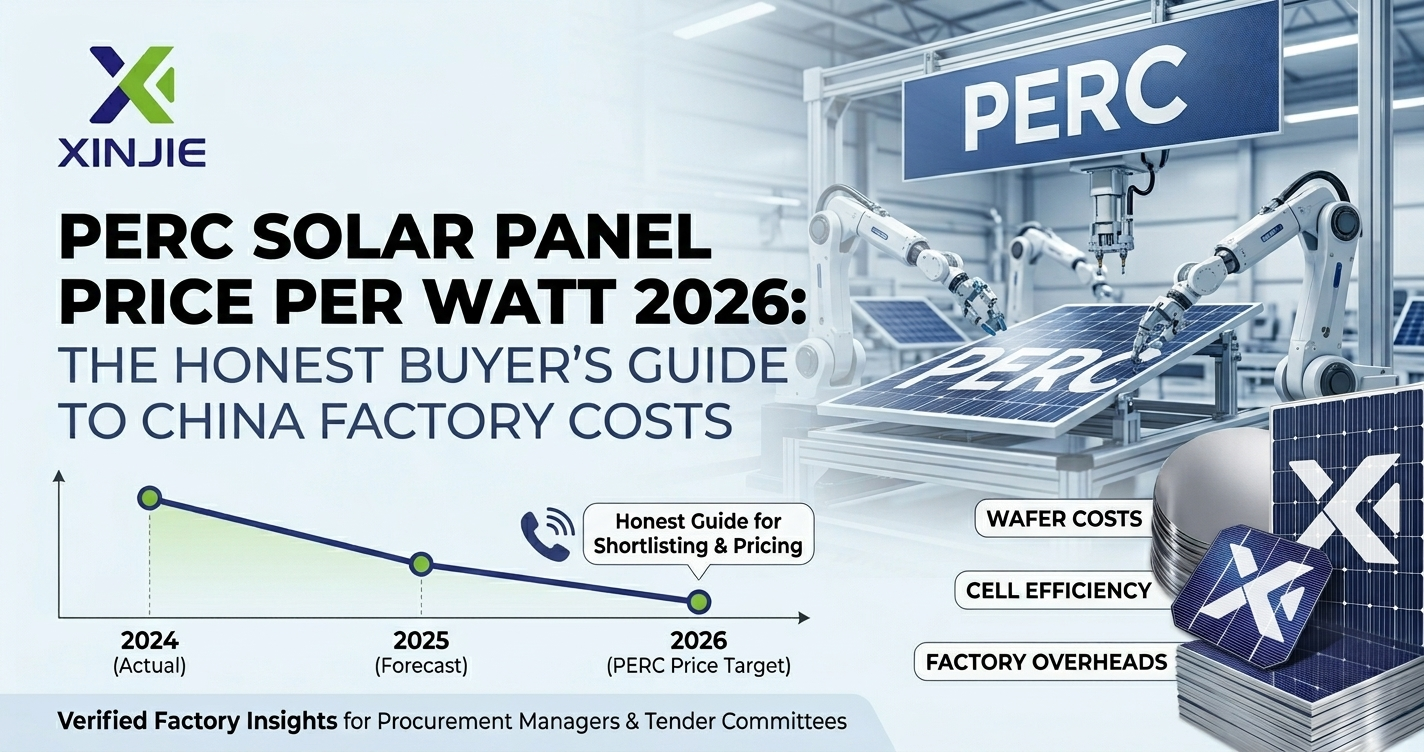
The Question Every Budget Buyer Is Really Asking
When a buyer from Lagos, Karachi, or Ho Chi Minh City contacts me and opens with "Mr. Xiao, what is the PERC solar panel price per watt right now?" — they are not really asking about a number. They are asking something deeper: Can I trust what I see on Alibaba? Am I about to overpay? Is this supplier going to disappear after I wire the deposit?
That conversation has happened hundreds of times in my career, and I have learned that the worst thing I can do is just throw out a cents-per-watt figure and move on. Price without context is useless. Sometimes it is dangerous. A buyer who finds an $0.07/W quote and jumps on it may be receiving clearance stock with expired certifications, or modules that measure 15W below their labeled output, or panels that arrive with microcracks from careless packing.
So this article is not going to give you a simple price tag and wish you luck. Instead, I want to give you the full picture: what market forces are shaping PERC prices right now, how to read a per-watt number correctly, why the same panel can cost dramatically different amounts depending on where it lands, and how Xinjie's pricing model actually works for budget-conscious buyers who still need quality they can stand behind.
If you are developing a small solar project in sub-Saharan Africa, installing systems for residential customers in South Asia, or sourcing inventory as a small-to-mid distributor in Southeast Asia — this guide is written specifically for you. We are going to talk in numbers that reflect the real 2026 market, not the 2023 price crash that some suppliers are still quoting to make themselves look cheap.
Let us get into it properly.
What Is Happening to PERC Solar Panel Prices in 2026?
To understand where PERC panel prices sit right now, you need to understand three things that happened in quick succession over the past eighteen months. None of them are obscure industry news — they are the forces that are directly affecting what you will pay when you request a quote today.
Force 1: China Eliminated Its 9% VAT Export Rebate
This is the most consequential policy change in Chinese solar manufacturing in years. One of the main triggers reshaping pricing in 2026 is Beijing's decision to eliminate export tax rebates on solar products. China's Ministry of Finance announced that, starting April 1, 2026, value-added tax rebates on photovoltaic exports would be permanently abolished.
What does that mean in practical terms? For years, Chinese solar manufacturers could export panels and reclaim a portion of the VAT they paid on inputs — effectively a government subsidy that made Chinese modules cheaper on the global market than they would otherwise be. That subsidy is now gone. Suppliers who previously priced aggressively on the assumption of the rebate now have to restructure their export economics. Buyers who were quoted prices in late 2025 and then waited until after April 2026 to commit found the landscape had changed.
Three simultaneous market forces drove projected Chinese solar panel price increases of 20–30% through 2026: the policy change of China eliminating the 9% VAT export rebate on April 1, 2026 (confirmed government policy), a manufacturing disruption from Chinese New Year compressing the procurement window, and surging material costs.
Force 2: Silver and Polysilicon Cost Pressure
Solar panels are not just silicon. The metallization paste used to print electrical contacts on PERC cells contains silver — and silver prices have been on a sustained upward trajectory. Combined with record silver prices, polysilicon supply discipline, government-mandated capacity shutdowns, and a three-week industry shutdown for Chinese New Year, significant procurement challenges have emerged for buyers in 2026.
In 2026–2028, silver paste consumption per watt and silver spot prices will explain more of the residual module price variance than polysilicon. Tracking silver alongside polysilicon is essential when forecasting module costs.
Force 3: PERC Is Being Phased Out of Tier-1 New Production
This is the part that most buyers do not know — and it changes how you should think about PERC pricing entirely. Mono PERC production at Tier-1 manufacturers ceased in stages through 2025. The remaining PERC inventory is being cleared at distressed prices in markets where bankability is less strict, such as small commercial, off-grid, and certain emerging markets.
This creates a genuinely unusual market situation. You can still find very competitive PERC pricing — sometimes lower than TOPCon on a per-watt basis — but you need to understand why it is cheap before you commit to a bulk order. Clearance stock from a winding-down production line is a different proposition from fresh-run certified modules from an active factory. I will explain how to tell the difference later in this article.
💡 Market Context from Mr. Xiao
The 2026 PERC market is a tale of two product pools: factory-fresh certified modules (increasingly scarce, priced at a new post-rebate baseline) and existing inventory being cleared by manufacturers pivoting to TOPCon. Both can be legitimate depending on your project requirements — but they are not the same product, and they should not be priced the same way. Always ask your supplier: "Is this new production or existing inventory?" A supplier who cannot answer that question clearly is not managing their supply chain transparently.
Price Breakdown: What You Actually Pay Per Watt (and Why)
Let me give you the numbers directly, because I know that is what you came here for. Then I will explain what each number actually represents.
Based on current market data and our own active procurement, here is the 2026 PERC single glass panel price landscape as of mid-year:
| Product Tier | Wattage Range | FOB China Price (H2 2026) | Who It's For |
|---|---|---|---|
| Generic / Unbranded PERC SG | 300W – 430W | ~$0.07 – $0.10/W | Off-grid / non-bankable projects; price-only buyers |
| Mid-Tier Certified PERC SG | 400W – 550W | ~$0.09 – $0.12/W | C&I rooftop; distributors needing CE/TUV |
| Branded PERC SG (LONGi / JA Solar) | 415W – 600W | +20 – 35% vs mid-tier | Bankable projects; resale with warranty chain |
| N-Type TOPCon (for comparison) | 580W – 720W | ~$0.085 – $0.110/W | Utility / premium C&I; efficiency-first buyers |
| OEM / Private Label PERC SG | Custom | MOQ-dependent — quote on request | Brand builders; regional distributors |
Now let me put those numbers in perspective. China's PV module prices are expected to hover around $0.12/W in H2 2026 under the influence of rebate removal and cost pressures. That figure applies broadly to standard crystalline silicon modules. PERC single glass modules — particularly existing inventory — can come in below that level. But the gap is narrowing, and quotes below $0.08/W in 2026 warrant serious scrutiny.
Here is what the per-watt number does not tell you:
Whether the panel will actually output its rated wattage. Low-tier suppliers routinely overstate module power. A 420W label on a panel that tests at 405W is a 3.6% loss that compounds across your entire project.
Whether the certifications are current and verifiable. An expired TUV certificate is not a TUV certificate.
What the total landed cost will be. FOB China and CIF Lagos are completely different numbers once you add freight, insurance, port handling, and import duty.
Whether the supplier will support you 18 months after delivery. Warranty paperwork is worth nothing if the issuing company no longer exists or does not answer emails.
Procurement success increasingly depends on contract structure, delivery buffers, and documentation readiness — not just the cents-per-watt headline. I cannot say that more clearly or more directly. The buyers who save money in this market are the ones who understand total project cost, not just module price.
⚠️ The "Too Cheap to Be True" Rule
If a supplier quotes you PERC single glass panels at $0.06/W or below in mid-2026, ask them immediately: (1) What is the production date of this batch? (2) Can you provide a current, verifiable TUV certificate? (3) What is the actual flash test report showing Pmax distribution for this lot? A legitimate supplier will answer all three within 24 hours. A supplier who deflects even one of those questions is selling you something you should not buy at any price.
Monocrystalline Panel Cost Comparison: PERC vs. TOPCon vs. Budget Tier
The question I get more than any other from budget-sensitive buyers is this: "Should I just move to TOPCon instead of PERC?" It is a fair question, and the honest answer is nuanced.
The TOPCon premium over mono PERC is currently 3–5%; the HJT premium over TOPCon is a further 2–8%. So on pure per-watt pricing, the gap between PERC and TOPCon is genuinely small now — and it is shrinking. TOPCon won because the cost gap to mono PERC narrowed to under 5% while the efficiency advantage held at 1.0–1.5 percentage points.
What this means in practice is that for large-volume commercial orders — where you are deploying megawatt-scale projects and every efficiency percentage point translates to fewer panels, smaller footprint, and lower balance-of-system cost — TOPCon is increasingly the economically rational default choice.
But PERC is not dead for budget buyers. Here is why PERC single glass still makes commercial sense in specific scenarios:
| Scenario | Best Choice | Reason |
|---|---|---|
| Off-grid rural electrification (Africa / South Asia) | ✅ PERC SG | Budget is primary constraint; bankability not required |
| Small rooftop residential (100–500W systems) | ✅ PERC SG | Lightweight, standard racking, proven for small systems |
| Distributor building entry-level product range | ✅ PERC SG | Lower price point attracts price-sensitive end customers |
| Mid-scale C&I rooftop (50kW – 500kW) | ⚖️ PERC SG or TOPCon | Depends on roof space, financier requirements, budget |
| Utility-scale ground-mount (1MW+) | ✅ TOPCon | BOS savings outweigh PERC price advantage at scale |
| Coastal / desert / high-humidity climate | ✅ Dual Glass | Single glass backsheet degrades faster in harsh environments |
The key insight here is this: standard mono PERC modules are typically the most cost-effective option, while TOPCon and HJT modules command a premium due to higher efficiency and better low-light performance. But mono-crystalline PERC remains the baseline option, widely supported, with good performance versus cost — and it remains the most cost-effective entry point for most projects and large-scale deployments in markets where efficiency-per-square-meter is not the binding constraint.
For my buyers in Nigeria building rural electrification systems, or in Pakistan installing rooftop systems for small commercial buildings, or in Vietnam sourcing inventory for the domestic retrofit market — PERC single glass is still the right product for the majority of your project pipeline. The calculus changes as you move upmarket, but for budget-first buyers in emerging markets, the product is not obsolete. It just requires smarter sourcing than it did three years ago.
Delivered Price by Region: Africa, South Asia, Southeast Asia, Middle East
FOB China is a starting point, not a destination. The number that actually matters for your project economics is the landed cost — what you pay once the panels are physically in your country, cleared through customs, and sitting in your warehouse or on your installation site. That number varies enormously by region.
Here is a practical regional reference based on mid-2026 market conditions for certified mid-tier PERC single glass modules:
| Destination Region | Approx. CIF Landed Cost | Sea Transit Time | Key Certification Needed |
|---|---|---|---|
| West Africa (Nigeria / Ghana) | +$0.03–0.05/W vs FOB | 25–35 days | CE / Intertek |
| East Africa (Kenya / Tanzania) | +$0.03–0.05/W vs FOB | 22–30 days | CE / TUV |
| South Asia (Pakistan / Bangladesh) | +$0.02–0.04/W vs FOB | 12–18 days | CE / Intertek |
| India | ~$0.13–0.16/W delivered (with BCD) | 10–15 days | BIS / ALMM — complex; verify first |
| Southeast Asia (Vietnam / Philippines) | +$0.015–0.03/W vs FOB | 7–14 days | CE / TUV |
| Middle East (UAE / Saudi Arabia) | +$0.02–0.04/W vs FOB | 18–25 days | TUV / Intertek |
| Europe (Germany / Poland) | ~$0.10–0.13/W delivered | 25–30 days | CE / TUV / UKCA (UK only) |
The India row deserves a separate note because it is the most complicated. India's Basic Customs Duty (BCD) on imported solar modules means that Chinese panels land at significantly higher effective costs than any other emerging market. Contract terms — EXW, FOB, CIF, and DDP — carry different responsibilities and costs including shipping, insurance, and duties, and this distinction is nowhere more financially significant than in the Indian market. If your primary target market is India, you need a very different procurement strategy than if you are sourcing for Pakistan or Bangladesh.
💡 Always Ask for CIF, Not Just FOB
When comparing quotes from multiple Chinese suppliers, request CIF pricing to your destination port. FOB comparisons look clean on paper but leave you exposed to freight rate volatility. In our experience, a supplier quoting a slightly higher FOB price but offering optimized freight routing can actually land cheaper than a lower-FOB competitor once you work out the logistics. At Xinjie, we model both FOB and CIF scenarios before sending a formal quotation, and we can arrange both sea freight (FCL and LCL) and air freight depending on your timeline and volume.
Five Pricing Mistakes That Cost Buyers More Than They Save
In fifteen years of solar supply chain work, I have watched buyers make the same mistakes repeatedly. These are not rookie errors — some of the most experienced procurement managers I have met have fallen into at least one of these traps. I am listing them here because I believe you deserve to know them.
Mistake 1: Chasing the Lowest FOB Quote Without Asking About Production Date
As I explained earlier, a lot of PERC single glass inventory currently on the market is clearance stock from Tier-1 manufacturers who have shifted their new production to TOPCon. That stock can be perfectly good — certified, undamaged, and competitively priced. But it can also be two-year-old inventory sitting in a warehouse in Hefei or Ningbo with degradation that has already begun. Ask specifically: "What is the production date of the specific batch you are quoting me?" Any hesitation or vague answer is a red flag.
Mistake 2: Ignoring the Watt-Class Tolerance
Solar panels are not manufactured to an exact wattage — they come off the production line within a tolerance range. A "420W panel" from a reputable manufacturer might actually be a 420W–430W panel (positive tolerance, which benefits you) or a 410W–420W panel (which is technically within spec but slightly below the nominal label). Cheap suppliers often sort and sell lower-output panels under the higher nominal label. Ask for flash test reports showing the actual Pmax distribution for your lot.
Mistake 3: Not Accounting for Degradation Rate in Long-Term Project Economics
A panel that costs $0.02/W less at purchase but degrades at 0.65%/year instead of 0.45%/year will produce measurably less power over a 25-year project life. Over a 500kW system, that gap in energy output translates into real revenue loss or missed client performance guarantees. Factory pricing improves with larger orders and longer commitments, but only if the product you are committing to has the performance specifications that justify the long-term investment.
Mistake 4: Comparing FOB Prices Across Different Incoterms
I have seen buyers compare one supplier's EXW quote with another supplier's CIF quote and declare the cheaper one a better deal. That is not a price comparison — it is comparing apples to shipping containers. Beyond the sticker price, understanding the full scope of costs — including shipping, tariffs, and soft costs — is essential for accurate comparisons. Always normalize to the same Incoterm before comparing.
Mistake 5: Skipping the After-Sales Structure Question
For budget buyers in emerging markets, the after-sales question feels less urgent than price. I understand that. But consider this: if 5% of your panels develop a defect within 24 months of delivery — a module performance issue, a junction box failure, a delamination problem — and your supplier either does not respond or tells you the claim process takes six months and requires you to ship panels back to China, what is the real cost of that "cheap" panel? At Xinjie, our after-sales structure is built into every order from day one. We provide 24-hour service responsiveness and we take direct ownership of quality resolution — not a third-party process that leaves buyers waiting.
📎 Want to understand which certifications matter for your specific export destination?
→ Read: CE, TUV, ETL, UKCA — Which Solar Panel Certifications Does Your Market Actually Require?
How Xinjie Prices Its PERC Single Glass Panels — and What That Means for You
I want to be direct about how we work at Xinjie, because I think transparency on pricing is the foundation of a good supplier relationship — and because too many Chinese suppliers hide behind vague language and "contact us for a quote" deflections that waste everyone's time.
Here is our pricing model in plain English:
We Do Not Have One Price. We Have a Price for Your Project.
Our pricing is order-specific. The key variables are: order quantity (larger volume = better per-watt rate), product specification (wattage, certified brand vs. generic, single glass vs. dual glass), delivery timeline, Incoterms, and destination port. When you contact us, we ask you for those specifics — not to avoid giving you a number, but because giving you an inaccurate generic number would be doing you a disservice.
Our PERC Single Glass Range and Current Position
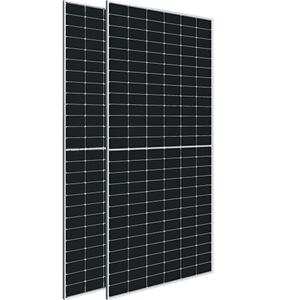
Our PERC single glass product range spans from compact 415W modules through to 600W P-type configurations. For buyers in Africa, South Asia, and Southeast Asia who need certified panels at competitive pricing, our mid-tier certified PERC single glass products represent what I genuinely believe is one of the better value propositions in the current market — not because we are the cheapest, but because our combination of certification breadth, shipping packaging standards, and after-sales responsiveness reduces the total cost of ownership in a way that a $0.005/W saving on the upfront quote does not.
Our Brand Panel Advantage
For buyers who need brand-backed warranty chains — particularly distributors reselling to project developers who have financing requirements — we are authorized distributors and partners for JA Solar (Official 2026), LONGi (Premium Strategic Partner), Huawei Digital Power (Silver Distributor), and SINENG Electric (2025–2026). This means we can supply branded panels with verified authorization, and the warranty chain goes directly to the manufacturer. That has real commercial value for buyers whose customers ask for manufacturer warranty letters.
Our Commitment on Pricing Transparency
We commit to four things on every quotation: (1) we give you both FOB and CIF pricing so you can compare properly; (2) we include the exact product specification — wattage range, certification, production date of the batch — so there are no surprises on arrival; (3) we confirm the shipping timeline at the time of quote, not after payment; (4) we provide original certification documents and verification links with every formal quotation, not just logos. That is the standard we hold ourselves to, and I encourage you to hold any supplier you work with to the same standard.
FAQ
Q1: What is the average PERC solar panel price per watt from a Chinese factory in 2026?
For mid-tier certified PERC single glass modules, current FOB China pricing in mid-2026 sits in the range of approximately $0.09–$0.12/W. Generic or unbranded PERC can go lower — down to $0.07–$0.10/W — but these typically represent existing inventory being cleared from production lines that have shifted to N-type technology. Branded PERC from Tier-1 manufacturers commands a 20–35% premium over mid-tier. All prices are significantly affected by the April 2026 VAT rebate removal, which eliminated a longstanding export subsidy for Chinese manufacturers. Always request a current quotation as prices are actively moving.
Q2: How has China's VAT export rebate removal affected PERC solar panel prices?
The removal of China's 9% VAT export rebate effective April 1, 2026, directly raised the cost floor for Chinese-manufactured solar panels. Previously, manufacturers could export panels and reclaim a significant VAT portion, effectively subsidizing their export pricing. That subsidy is now gone. Buyers who committed to orders before April 2026 secured better pricing. For post-April procurement, the new baseline reflects this structural cost change. Industry analysts indicate an overall 20–30% price increase compared to the 2025 market lows.
Q3: Is PERC still the cheapest solar panel option in 2026 compared to TOPCon?
In many cases, yes — but the gap is narrowing significantly. The TOPCon premium over mono PERC is now approximately 3–5% on a per-watt basis, while offering 1.0–1.5 percentage points of additional efficiency. For budget-first buyers in off-grid or small-scale applications, PERC remains the cost-effective choice. For utility-scale or premium C&I projects where efficiency translates into meaningful balance-of-system savings, TOPCon is increasingly the rational default even for budget-conscious buyers. Contact Xinjie to model the real economics for your specific project scale and site conditions.
Q4: What is the minimum order quantity to get wholesale pricing on PERC panels from Xinjie?
We accommodate orders starting from small sample quantities through to full container loads. For commercial wholesale pricing tiers, orders typically start at 100+ panels. Buyers ordering 500kW or more receive dedicated pricing discussions and logistics support. For project developers in Africa or South Asia working with constrained budgets and phased project delivery, we can also discuss structured pricing tied to delivery milestones. Tell us your project scope and we will give you a tailored response within 24 hours.
Q5: What is the delivered cost of Chinese PERC panels to African markets in 2026?
For West and East African destinations, sea freight, insurance, and port handling typically add $0.03–$0.05/W on top of the FOB China price, with transit times of 22–35 days depending on the destination port. Import duties vary significantly by country — Kenya, Tanzania, Ghana, and Nigeria all have different tariff structures for solar panels. Xinjie can arrange both FCL (full container load) and LCL (less-than-container load) shipments, and we provide full shipping documentation to support your import clearance process.
Q6: How do I compare solar panel quotes fairly when suppliers use different Incoterms?
Always normalize to the same Incoterm before comparing. Request CIF (Cost, Insurance, Freight) to your destination port from every supplier. EXW and FOB quotes exclude freight, which means a supplier quoting EXW at $0.085/W might land more expensive than a supplier quoting CIF at $0.11/W once you add actual freight costs from China to your port. At Xinjie, we provide both FOB and CIF pricing in our formal quotations so you have a genuine basis for comparison.
Q7: Can I get a discount on PERC solar panels if I place a large bulk order?
Yes. Volume pricing is a real and meaningful lever for buyers who can commit to larger orders. At Xinjie, we offer tiered pricing based on order quantity, and buyers who can commit to full container loads (typically 500–600 panels per 40HQ container for standard PERC modules) receive materially better per-watt rates than small-lot buyers. For project developers who can confirm multi-MW annual purchasing volumes, we discuss framework agreements that provide price stability and delivery priority over a defined period.
Get a Real Per-Watt Price for Your Project — Not a Catalogue Number
Tell Mr. Xiao your destination market, project size, and required certifications.
You will receive a transparent, itemized quotation with FOB + CIF pricing within 24 hours.
📞 +86-19072080183 | 📠 027 86521066 | 📍 No.1001, Shun'an Building, Hongshan District, Wuhan, Hubei, China
Mr. Xiao
Senior Solar Sourcing Specialist — Hubei Xinjie New Energy Technology Co., Ltd.
Mr. Xiao has over fifteen years of direct experience in China's photovoltaic supply chain, spanning manufacturing operations in Hefei and international trade from the Wuhan sales office. He works daily with distributors, EPC contractors, and project developers across Africa, South Asia, Southeast Asia, and the Middle East — helping them navigate pricing volatility, certification requirements, and supplier qualification. His writing reflects conversations that happen on the ground, not data aggregated from a desk.
References
JMB iPV Tech (February 2026). How Chinese Solar Module Prices Are Shifting in the Global Market. jmbipvtech.com
CouleeEnergy (January 2026). Chinese Solar Panel Prices 2026: Strategic Procurement Guide. couleenergy.com
SurgePV (May 2026). Solar Module Price Forecast 2026–2028: Polysilicon, Tariffs & Regional Price Gaps. surgepv.com
ESZoneo (2026). Solar Panel Prices in China: A Global Buyer's Sourcing Guide for 2026. eszoneo.com
Rinnovabili.net / pvXchange Trading (February 2026). Photovoltaic Module Prices 2026: Solar Panel Costs Rise Again. rinnovabili.net
Accio.com (March 2026). Solar Panels Price Per Watt in 2026. accio.com
BloombergNEF (referenced via SurgePV, 2026). Global PV Market Outlook 2026. bloombergnef.com
InfoLink Consulting (referenced via SurgePV, 2026). Weekly Spot Price Reports — Solar Modules. infolink-group.com
Hubei Xinjie New Energy Technology Co., Ltd. (2026). Official Company Profile, Certifications & Product Catalogue. xinjieenergy.com