OEM PERC Solar Panel Manufacturer China: The 2026 Decision-Stage Guide to Building Your Private Label Brand

Mr. Xiao — Senior Solar Sourcing Specialist
Hubei Xinjie New Energy Technology Co., Ltd. | 15+ Years in PV Supply Chain | Wuhan, China
📋 Table of Contents
[ Toggle ]Why More Distributors Are Building Private Label Solar Brands in 2026
OEM vs. ODM vs. White-Label: Getting the Definitions Right Before You Sign Anything
Why China — and Specifically Hefei, Anhui — Is the Right Manufacturing Base
The OEM PERC Panel Process: Seven Stages from Brief to Shipment
Certifications on OEM Panels: What Transfers, What You Need to Reapply For
Six OEM Mistakes That Kill Private Label Solar Brands Before Launch
How Xinjie Handles OEM / ODM: A Transparent Look at What We Actually Do
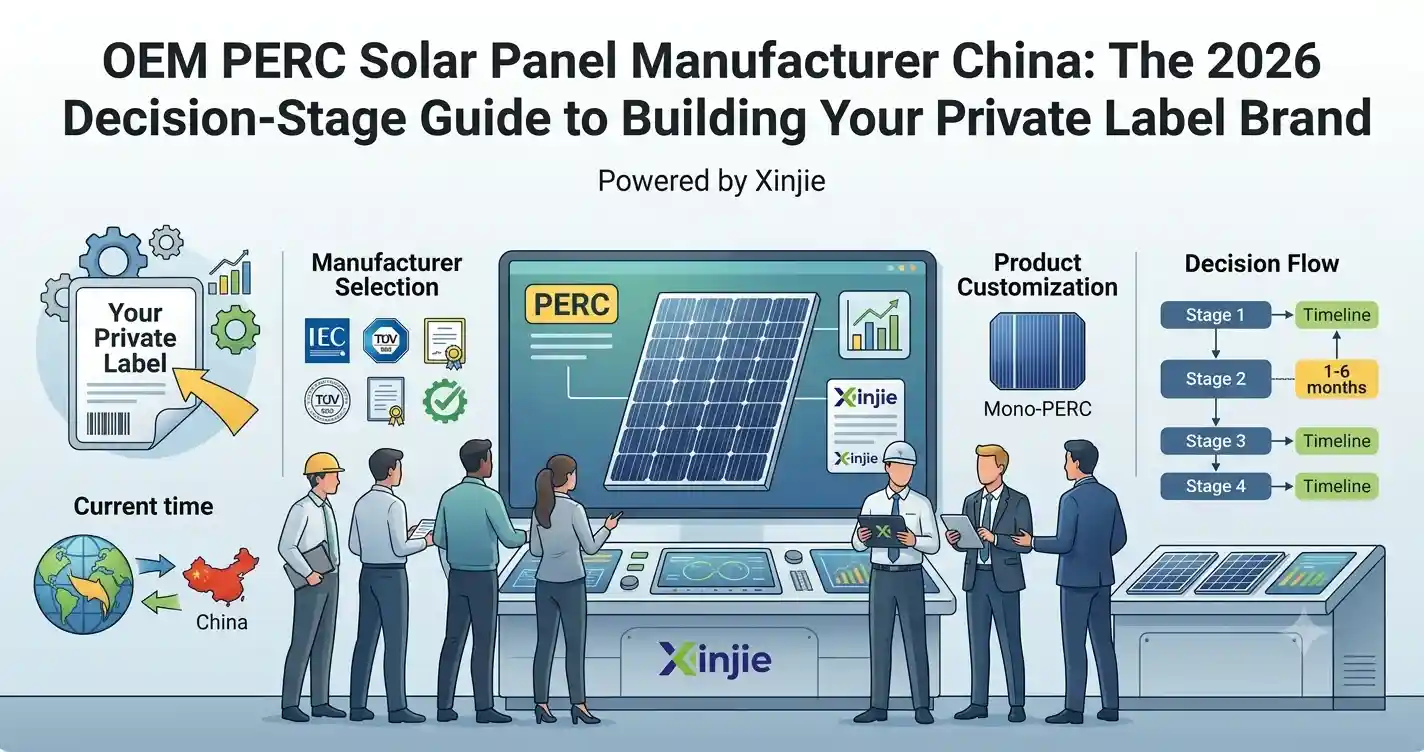
Why More Distributors Are Building Private Label Solar Brands in 2026
In the last eighteen months, I have had a version of the same conversation with distributors from Germany, the United States, Australia, and Canada. The conversation used to start with "We need a reliable PERC panel supplier." Now it starts differently: "Mr. Xiao, we want to stop being just a reseller. We want to build our own brand."
That shift is not a coincidence. It reflects three structural changes happening simultaneously in the global solar distribution market.
First, margin compression. China remains the most important sourcing base for solar panels in 2026 because it combines scale, technology depth, supplier variety, and cost competitiveness — which means every distributor in every market is sourcing from more or less the same Chinese factories. When everyone sells the same product, the only competition is price. Private label breaks that race to the bottom by creating a product identity that your customers associate with your service quality and warranty support, not with a Chinese manufacturer they have never heard of.
Second, warranty chain ownership. When you resell a branded panel, the warranty relationship sits between the end customer and the original manufacturer in China. You are a pass-through in that chain. When something goes wrong two years after installation — a junction box failure, a delamination issue, a performance shortfall — your customer calls you, but you have no direct leverage over the manufacturer. Building a private label means the warranty is yours to manage and yours to design. That sounds like more risk, but handled correctly, it is actually more control.
Third, brand equity accumulation. Warranty quality is becoming a bigger differentiator — many factories advertise long power warranties, but buyers should review the company behind the warranty, the claim process, and the financial strength of the guarantor. A distributor who builds a private label brand over three to five years creates an asset — customer recognition, repeat purchase loyalty, and the ability to command a modest premium over unbranded commodity panels — that a straight reseller never builds.
This guide is written specifically for buyers who have already decided they want to pursue OEM manufacturing in China and are now in the decision phase: evaluating factories, understanding the process, assessing the risks, and determining whether a specific supplier — including Xinjie — is the right partner for what they are trying to build.
I am going to give you the full picture. That includes the parts that are genuinely challenging, because I believe buyers who walk into an OEM relationship with accurate expectations are far more likely to build a successful brand than those who discover complications after the deposit has cleared.
OEM vs. ODM vs. White-Label: Getting the Definitions Right Before You Sign Anything
These three terms are used interchangeably by many suppliers — which creates significant confusion and, occasionally, significant commercial misunderstanding. Let me define them precisely.
| Model | What It Means | Customisation Level | Typical MOQ | Lead Time |
|---|---|---|---|---|
| White-Label | Factory's existing standard panel; your brand sticker applied to frame or packaging only | Minimal | 50–200 units | 2–4 weeks |
| ODM | Factory's base design, modified per your specifications — wattage range, frame colour, junction box type, documentation language | Moderate | 200–500 units | 6–10 weeks |
| Full OEM | Your specification from the ground up — unique dimensions, custom cell layout, proprietary wattage class, your certification filing | Full | 500–1,000+ units | 10–16 weeks |
In an OEM arrangement, the factory builds to your specification, while an ODM starts from its own base design and lets you modify parts of it. Neither route is automatically better — the right choice depends on how much of the product's specification, branding, and compliance file must be unique to your brand.
For most distributors entering the private label solar market for the first time, I recommend starting with an ODM approach. Here is my reasoning: a full OEM product requires your own certification filing — which means CE, TUV, and market-specific certifications will carry your brand name, not the factory's. That is commercially valuable in the long run, but it requires time and cost investment upfront. An ODM product can leverage the factory's existing certification framework while still giving you meaningful brand differentiation through custom documentation, packaging, and frame branding.
Manufacturers promising a fully custom OEM order in under 15 days are likely not performing true customization. A genuine OEM production run involves four distinct stages: Technical Review (3–5 Days): Ensuring the electrical layout matches your target system; Custom Tooling/Cell Cutting (5–7 Days); and so on through Lamination, Curing, and final testing. Any supplier who quotes you a two-week turnaround on full OEM customization is either being misleading about what they are actually doing, or cutting corners on the steps that protect your product quality.
The strategic progression I suggest to first-time private label buyers is this: start with white-label to test your market, transition to ODM when you have 6–12 months of sales data confirming demand, and consider full OEM only once you have stable volume commitments and the budget to fund your own certification filings. At Xinjie, we support buyers at all three stages and we actively advise which stage is right for a specific buyer's situation — not just push everyone toward the highest-complexity, highest-margin engagement.
💡 Mr. Xiao's Starting Point Recommendation
If you are launching a private label solar brand and you have not yet sold your first container under your own brand name, do not start with full OEM. Start with white-label or ODM. Build your market confidence, refine your product specification based on real customer feedback, and scale into deeper customization once you know what your specific customers actually value. I have seen too many first-time brand builders invest in custom tooling and full certification filing for a product that the market then tells them is the wrong spec. Test small. Validate. Then invest in the full brand asset.
Why China — and Specifically Hefei, Anhui — Is the Right Manufacturing Base
The case for China as a private label solar manufacturing base does not need much building in 2026. China remains the undisputed powerhouse of global solar panel manufacturing, supplying more than 80% of the world's photovoltaic components. From silicon wafers to fully assembled solar modules, Chinese manufacturers lead the way in both technological innovation and production scale, with a robust supply chain stretching from raw materials to finished products giving it a strategic advantage unmatched by any other region.
China's advantage in solar manufacturing comes from supply chain depth — large manufacturers often control multiple production stages, from silicon materials and wafers to cells, modules, frames, and packaging. For an OEM buyer, this integration means your private label product is sourced within a single coherent supply ecosystem, not assembled from components sourced across five different countries with five different quality management systems.
But within China, not all manufacturing locations are equal. The specific question for an OEM buyer is not just "China" — it is "which part of China, and why does that matter?"
Hefei, Anhui: China's PV Manufacturing Heart
Provinces with robust industrial infrastructure and deep talent pools have emerged as focal points of technological leadership. Over the past two decades, the majority of valid invention patents in China's solar industry has been clustered in manufacturing centers such as Jiangsu, Zhejiang, and Anhui, as well as in talent-rich hubs — and these manufacturing centers are not only high-capacity production sites but also innovation engines, generating local ecosystems that complement breakthroughs coming from major research labs.
Anhui Province is a significant region with a growing presence in the solar manufacturing sector, increasingly attracting investment and developing its own specialized segments within the PV industry. These industrial clusters offer distinct benefits for B2B buyers — proximity to raw material suppliers and specialized component producers reduces procurement complexity and lead times, and regional government incentives and supportive policies further enhance the operating environment for manufacturers. Buyers sourcing from these areas gain access to mature ecosystems designed for efficient large-scale photovoltaic production.
Mega-factories in provinces like Jiangsu, Anhui, and Zhejiang operate at capacities exceeding 20 GW annually — which is the production environment that makes competitive OEM pricing possible. When the suppliers of EVA film, backsheets, junction boxes, silver paste, and aluminium frames are all within a 50-kilometre radius of the module assembly line, the cost of components and the speed of procurement are fundamentally different from what any non-Chinese OEM base can achieve.
Xinjie's production line and R&D department are based in Hefei, Anhui — which puts us directly inside this ecosystem. Hefei City, Anhui Province, is one of the main production bases of the photovoltaic industry in the world. Our Hefei team provides direct production oversight, real-time quality monitoring, and OEM customisation management from within the supply cluster — not remotely from a trading office in a coastal city. That proximity matters for OEM buyers because it means your product changes are implemented on the actual production floor, not communicated through a chain of intermediaries.
⚠️ Factory vs. Trading Company: The Question You Must Ask
Ask your supplier directly: "Are you a source factory or a trading company?" A genuine source factory will have a business license listing "Solar Module Production" and should be able to provide a raw production line video. You should look for in-house R&D patents and a dedicated testing lab featuring EL testers and solar simulators to confirm they control the entire quality process. At Xinjie, we are a production-linked operation with our manufacturing and R&D in Hefei and our sales organisation in Wuhan. We can provide production line documentation, factory registration details, and third-party audit access for any buyer who wants to verify before committing.
The OEM PERC Panel Process: Seven Stages from Brief to Shipment
One of the most common sources of frustration I see in OEM relationships is misaligned expectations about what the process involves and how long it takes. Buyers assume it is a straightforward "send us your logo, we print it on the panel." The reality of a properly executed OEM engagement is considerably more structured — and for good reason. Every stage protects your product quality and your brand reputation.
Here is the seven-stage process as Xinjie implements it:
| Stage | Activity | Typical Duration | Buyer Deliverable Required |
|---|---|---|---|
| 1 | Product Brief & Specification Agreement | 3–5 days | Target market, wattage range, frame colour, certification requirements, documentation language |
| 2 | Technical Review & Feasibility | 3–5 days | Confirmation of electrical specifications, cell layout, junction box spec |
| 3 | Branding Design & Artwork Approval | 5–7 days | Brand logo files (vector format), colour codes, label content, packaging artwork |
| 4 | Sample Production & EL Testing | 7–14 days | Sample approval — sign-off on appearance, labelling, and flash test report |
| 5 | Bulk Production Run | 10–20 days | Deposit payment; third-party inspection authorisation (if applicable) |
| 6 | Pre-Shipment Inspection & Documentation | 3–5 days | Balance payment; shipping instructions; import documentation requirements |
| 7 | Shipment & Post-Delivery Support | Transit: 7–35 days | Tracking confirmation; arrival inspection; warranty documentation filing |
Lead time for custom OEM production varies by project complexity — typically 25 to 40 business days after design confirmation and deposit receipt. Projects requiring new tooling, specialised materials, or third-party certification testing may require additional time.
The stage that most first-time OEM buyers underestimate is Stage 4 — Sample Production and EL Testing. I strongly recommend that every buyer, regardless of how well they know the factory, physically reviews the OEM sample before approving bulk production. This is not about distrust. It is about catching specification interpretation errors before they multiply across 500 panels. A label that is 2mm off-centre on a sample is insignificant. The same label placement across an entire container is a brand quality problem. See the sample. Approve it explicitly. Then proceed to bulk production.
Requesting samples from a China factory before bulk payment is a practical way to confirm workmanship, packaging, and documentation quality. Use four checkpoints: raw material review, mid-production inspection, finished goods testing, and container loading supervision. For first orders or large project shipments, a pre-shipment inspection by an independent third party is the safest way to confirm appearance, labels, power rating, packaging, and quantity before the balance payment is released.
MOQ, Lead Time, and Pricing: What to Realistically Expect
Let me give you the numbers directly, because this is the section buyers turn to first and the section where supplier marketing is often most misleading.
Minimum Order Quantities
Spot inventory usually starts around 500 to 1,000 modules. Custom frames, printed logos, or non-standard dimensions usually require higher quantities. But that headline figure needs context. To lower the barrier for startup brands, tiered MOQs are available: simple branding on existing models starts at 50–100 units, while deep customisation involving new dimensions or electrical layouts typically requires 200–500 units.
The practical breakdown I use at Xinjie:
| Customisation Scope | Typical MOQ (Xinjie) | What Is Included |
|---|---|---|
| Logo + Packaging Only (White-Label) | From sample qty up | Brand sticker / label; custom outer carton design |
| ODM: Frame branding + custom docs | MOQ-dependent — quote on request | Branded frame label, custom datasheet, custom warranty certificate |
| Full OEM: Custom spec + certification | MOQ-dependent — quote on request | Proprietary spec, your certification filing, custom dimension option |
One critical MOQ trap that I see repeatedly: a supplier quotes "100-piece MOQ" but that applies to standard models only — your customisation significantly increases the minimum order requirement. Always ask explicitly: "Does your MOQ include custom modifications?" and get written confirmation.
Realistic Lead Times
At Xinjie, our standard dispatch commitment for in-stock products is 7 working days. For OEM and ODM orders, lead times are longer and depend on customisation complexity. As a planning reference: lead time for custom OEM production is typically 25 to 40 business days after design confirmation and deposit receipt. Projects requiring new tooling, specialised materials, or third-party certification testing may require additional time. Standard catalogue product lead times are generally shorter.
OEM Pricing Structure
OEM orders often yield better pricing compared to spot market purchases at equivalent volumes, because the factory can plan production runs efficiently and amortise setup costs across a confirmed order. The per-watt OEM price for PERC single glass in the current 2026 market reflects the base module cost plus the customisation premium — which varies based on: (1) complexity of branding modifications, (2) whether new tooling is required, (3) the certification pathway chosen, and (4) total order volume.
I do not publish a generic OEM price list because a meaningful price requires knowing your specific order scope. What I can tell you is that buyers committing to regular volume — multiple containers per quarter with consistent specifications — receive materially better economics than one-time order buyers. Building a private label brand is a relationship, not a transaction, and pricing reflects that accordingly.
💡 The Phase-In Strategy for New OEM Buyers
Use standard models for Phase 1 and Phase 2 of your launch. Add customisation only in Phase 3 when you know exactly what sells. This is not timidity — it is smart capital allocation. Your first 200 panels should validate your market, not stress-test your balance sheet with tooling investment and certification filing costs. Once you have 12 months of sales data, you have the evidence base to invest in full OEM with confidence.
Certifications on OEM Panels: What Transfers, What You Need to Reapply For
This is the section that surprises most first-time private label buyers — and it is one of the most commercially important topics to understand before you commit to an OEM relationship.
Here is the core principle: certifications are issued to a specific product model under a specific brand name. When you change the brand name on the panel, you do not automatically inherit the factory's existing CE, TUV, or ETL certification. The panel may be physically and electrically identical to the certified model, but the certificate carries the factory's name and model designation — not yours.
What This Means in Practice
A certification only proves a single sample passed a test; a true OEM partner must provide batch-specific test reports. Certificates from TÜV or UL confirm the product design is safe, but continuous quality relies on ISO 9001 systems and 100% EL inspection of every cell string. A reliable factory should be able to provide thermal imaging and flash test data for your specific production batch upon request.
For OEM buyers, the certification pathway depends on what you are selling and where:
| OEM Approach | Certification Status | What Buyers Need to Do | Cost Implication |
|---|---|---|---|
| White-Label (Factory Brand Name Unchanged) | Factory's existing certs remain valid | Verify cert applies to exact model number supplied | None additional |
| ODM (Factory Base Design, Your Brand) | Factory certs do NOT cover your brand name — new filing needed | File for CE/TUV under your brand name using factory's production test data | $3,000–$8,000+ per market |
| Full OEM (Custom Spec, Your Brand) | Entirely new product — requires independent certification filing | Commission full IEC 61215/61730 test programme through TUV/ETL/Intertek | $8,000–$20,000+ depending on markets |
This certification reality is one of the key reasons I recommend ODM before full OEM for first-time private label buyers. ISO 14001 environmental management certification, renewable energy use documentation, and lifecycle carbon data can all matter for EU and US corporate procurement — and buyers should confirm that each credential applies to the specific factory producing the order, not only to the supplier's corporate group.
At Xinjie, we currently hold the following certifications on our own PERC single glass product range: CE, TUV SUD, TUV Nord, UKCA, ETL (Single Glass), CGC, CNAS Laboratory Certificate, Intertek Laboratory Certificate (×2), IAF TUV, PID, and TUV Dynamic Mechanical Load. For ODM buyers who want to build their own brand on top of our production, we provide the factory-level test documentation and certification support to facilitate your own brand filing with the relevant certification bodies.
📎 Need to understand which certifications apply to your specific target market (EU / UK / US / Australia)?
→ Read: CE, TUV, UKCA, ETL — Which Solar Panel Certifications Does Your Market Require?
Six OEM Mistakes That Kill Private Label Solar Brands Before Launch
I have watched private label brands succeed and I have watched them fail. The failures tend to cluster around the same six mistakes. I am listing them here not to be discouraging but because forewarned is forearmed — and because understanding these failure modes is exactly the kind of due diligence a decision-stage buyer should be doing.
Mistake 1: Selecting an OEM Supplier Based Purely on Price
Choosing the factory is less about finding the cheapest quote and more about finding the supplier that can repeatedly build the same safe product. An OEM panel carries your brand name. When a panel fails in front of a customer, the customer calls you — not the factory in Hefei. The reputation damage flows to your brand, not to the manufacturer. Price is a factor in OEM supplier selection, but it should rank third or fourth, behind quality consistency, certification capability, and after-sales responsiveness.
Mistake 2: Not Getting the Specification Document Right Before Production
The specification sheet should describe the product in a way that leaves little room for interpretation. If the factory can read your sheet and still build three materially different versions, the document is not ready. An underspecified brief results in a product that "matches the spec technically but is not what we wanted." That conversation happens after deposit payment, never before. Define: wattage tolerance, frame colour (RAL code, not "black"), junction box IP rating, cable length and connector type, label language, and packaging standard. Leave nothing to interpretation.
Mistake 3: Skipping the Sample Approval Stage
I have already said this, but it bears repeating: approving bulk production without seeing a physical sample is one of the most expensive shortcuts a private label buyer can take. The production batch may not match samples, with panels arriving with performance issues, poor junction box attachment, or inadequate packaging causing damaged goods. One container of panels with the wrong label placement or a branding error that was visible on the sample but not caught costs you the product, the freight, and the customer relationship.
Mistake 4: Assuming the Factory's Certifications Cover Your Brand
As I explained in the previous section — they do not. A CE certificate issued to "Xinjie PERC-415W" does not cover "YourBrand PERC-415W," even if the physical panel is identical. Buyers who discover this at the point of market entry — after the panels have arrived at the warehouse — face a painful choice between selling uncertified product (market access risk) or absorbing the cost of a rushed certification programme. Address the certification pathway at the specification stage, not the delivery stage.
Mistake 5: Under-Estimating the Documentation Workload
A private label panel is not just a panel with your logo — it is a product with a full documentation suite: datasheet, installation manual, warranty certificate, and declaration of conformity. All of these must carry your brand name, and all of them must be accurate. A datasheet that lists the wrong efficiency rating, a warranty certificate that references the wrong model number, or an installation manual with mistranslated safety instructions are all quality problems that erode brand credibility before the first panel is installed.
Mistake 6: No After-Sales Infrastructure
The most common thing I see private label brand builders overlook is the question: "What is our after-sales process?" You are now the warranty party. Your customer will contact you — not the factory — when something goes wrong. If you do not have a clear, documented warranty claim procedure before you launch, you are building a reputation liability. At Xinjie, our after-sales support for OEM partners includes 24-hour response capability and direct ownership of quality issues on production batches we have manufactured. But your customer-facing warranty process is yours to design and own.
How Xinjie Handles OEM / ODM: A Transparent Look at What We Actually Do
I want to be specific and direct about Xinjie's OEM capability, because I think buyers in the decision stage deserve clarity rather than marketing language.
Our Production Base: Hefei, Anhui
Our production line and R&D team are located in Hefei, Anhui Province — one of China's core PV manufacturing hubs. This is not a satellite assembly facility or a third-party contract manufacturer relationship. It is our own production operation, which means we have direct control over the manufacturing process, direct responsibility for the quality output, and direct access for third-party inspections requested by buyers. We mean that literally — if you want to send an SGS, Bureau Veritas, or TUV inspector to our Hefei facility before committing to an OEM order, we welcome it. We have never turned down a legitimate factory audit request.
Our OEM Product Range
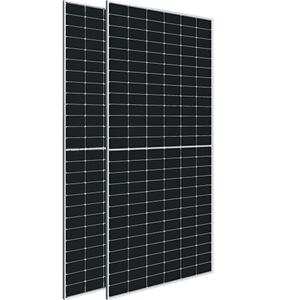
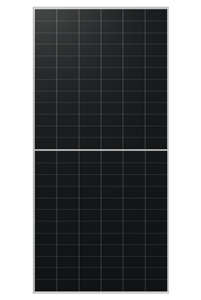
Our PERC single glass range available for OEM manufacturing spans from 415W residential compact modules through to 600W P-type commercial configurations. All base products in our OEM range are manufactured with half-cut monocrystalline PERC cells and standard residential frame dimensions. We support:
Custom frame branding — engraved or printed brand name on the aluminium frame
Custom label design — full label artwork development, including your brand identity, compliance markings, and QR traceability codes
Custom documentation — datasheet, installation manual, and warranty certificate in your brand identity and target market language
Custom packaging — branded outer carton and inner packaging materials
Specification adaptation — within the design envelope of our production capability, we can adjust wattage class, frame colour, and junction box specification
Our In-House R&D Team
What differentiates Xinjie's OEM service from a straight trading company offering white-label panels is our in-house R&D team in Hefei. This team is responsible for product development, specification feasibility assessment, and OEM customisation technical review. When a buyer brings us a specification requirement, our R&D team evaluates it against our production capability before we quote — which means we do not take orders we cannot fulfil technically. That saves everyone time and avoids the disappointment of committed orders that cannot be manufactured as specified.
Our After-Sales Commitment for OEM Partners
For OEM buyers, after-sales is not a brochure promise — it is the operational backbone of your private label brand's reputation. At Xinjie, we provide 24-hour service responsiveness and direct quality ownership on production batches we manufacture. For OEM buyers specifically, we provide batch-level flash test reports, EL test documentation, and production QC records that allow you to stand behind your product warranty with full evidentiary support if a claim arises.
We ship OEM orders via sea freight (FCL and LCL) and air freight, with our standard packaging — cardboard corner protection on all four panel corners and individual panel separation packaging — applied to every OEM shipment regardless of order size. Your brand's first impression to your customer is the unboxing experience. We take that seriously.
📎 Want to compare PERC pricing before deciding on OEM vs. buying branded panels?
→ Read: PERC Solar Panel Price Per Watt 2026 — The Honest Buyer's Guide to China Factory Costs
📎 Selling into the UK or EU market? Understand the certification requirements first.
→ Read: Single Glass PERC Solar Panel for Rooftop Installation — The 2026 Installer's Complete Guide
FAQ
Q1: What is the difference between OEM, ODM, and white-label for solar panels?
White-label means applying your brand to a factory's existing standard product with minimal modification — lowest MOQ and fastest lead time, but least differentiation. ODM means using the factory's base design with modifications to specification, branding, and documentation — moderate MOQ and a 6–10 week lead time. Full OEM means a product built entirely to your specification from the ground up — highest MOQ, longest lead time (10–16 weeks), and full control over product design and certification filing. For first-time private label solar brands, ODM is typically the most practical entry point before scaling to full OEM.
Q2: Does Xinjie's CE and TUV certification cover panels manufactured under my brand name?
No — and this is one of the most important things to understand before entering an OEM relationship. Certifications are issued to a specific model under a specific brand name. When your brand name appears on the panel, you need your own certification filing — even if the underlying panel is physically identical to our certified product. Xinjie provides all factory-level production test documentation, EL test reports, and technical files to support your own brand's certification application with TUV, Intertek, ETL, or the relevant certification body for your target market. We advise all OEM buyers to address certification planning at the brief stage, not after production.
Q3: How do I verify that Xinjie is a real factory and not a trading company?
We welcome verification at any stage of the inquiry process. We can provide: (1) our business licence listing production activities; (2) raw production line video from our Hefei facility; (3) documentation of our in-house R&D team and testing laboratory; and (4) open access for third-party factory audit by any internationally recognised inspection body (SGS, Bureau Veritas, TUV, Intertek) you choose to commission. Our production line and R&D department are based in Hefei, Anhui Province — one of China's core photovoltaic manufacturing hubs. We have never refused a legitimate factory verification request from a prospective OEM buyer.
Q4: What customisation options are available for OEM PERC single glass panels from Xinjie?
For ODM and OEM orders, we support: custom frame branding (engraved or printed brand name on the aluminium frame); custom label design including your brand identity and compliance markings; custom documentation suite (datasheet, installation manual, warranty certificate) in your brand identity and any target language; custom packaging (branded outer carton and inner protective materials); and specification adaptations including wattage class adjustment, frame colour, and junction box specification. Full custom dimensions are available for confirmed full OEM orders at appropriate volumes.
Q5: How long does a typical OEM PERC panel order take from brief to shipment?
The full OEM timeline from specification agreement to shipment is typically 6–12 weeks depending on customisation complexity. The key stages are: specification agreement and technical review (1 week), branding artwork approval (1 week), sample production and approval (2 weeks), bulk production run (2–3 weeks), and pre-shipment inspection and documentation (1 week). Projects requiring new tooling, custom dimensions, or new certification filings will extend this timeline. We provide a project-specific timeline estimate at the quotation stage so you can plan your market launch accurately.
Q6: Why is Hefei, Anhui a good location for OEM solar panel manufacturing?
Hefei is located within one of China's three primary photovoltaic manufacturing clusters — alongside Jiangsu and Zhejiang. The city hosts major solar manufacturers and an integrated supply chain of component suppliers for EVA film, backsheets, junction boxes, aluminium frames, and silver paste, all within close proximity. This supply chain concentration reduces component lead times and costs, allows rapid specification modification, and supports the kind of flexible OEM production that private label buyers need. The Anhui provincial government also provides supportive policies for high-tech manufacturing including solar PV, which reinforces the operating environment for manufacturers in the region.
Q7: What after-sales support does Xinjie provide to OEM panel buyers?
For OEM and ODM buyers, Xinjie's after-sales support includes: 24-hour service responsiveness for quality issues; batch-level flash test reports and EL test documentation for every production run; production QC records that support your own brand warranty claims; and direct quality ownership on any defects attributable to our production. We do not route OEM buyer quality issues through a third-party claims process — we take direct responsibility. Our packaging standard (cardboard four-corner protection and individual panel separation) is applied to all OEM shipments to protect product integrity during transit.
Ready to Build Your Own Solar Panel Brand with Xinjie?
Share your target market, product specification, and branding brief with Mr. Xiao.
We will send you an OEM feasibility assessment and indicative pricing within 24 hours — no commitment required.
📞 +86-19072080183 | 📠 027 86521066 | 📍 No.1001, Shun'an Building, Hongshan District, Wuhan, Hubei, China
Mr. Xiao
Senior Solar Sourcing Specialist — Hubei Xinjie New Energy Technology Co., Ltd.
Mr. Xiao has over fifteen years of direct experience in China's photovoltaic supply chain, spanning manufacturing operations in Hefei and international trade from the Wuhan office. He has guided multiple European, American, and Australian distributors through the OEM and private label solar panel development process — from initial specification brief to first container delivery. His writing draws on real project experience, not theoretical frameworks, and is intended for buyers who are serious about making informed, well-structured decisions.
References
MapleSourcing (June 2026). China Solar Panel Manufacturers: Top 10 for 2026. maplesourcing.com
Sungold Solar (March 2026). OEM Flexible Solar Panel Manufacturer China: 2026 Sourcing Guide. sungoldsolar.com
Sungold Solar (May 2026). Solar Panel FAQ: Custom, Flexible, OEM & B2B Sourcing Questions. sungoldsolar.com
CouleeEnergy (January 2026). MOQ for Flexible Solar Panels: Guide to Importing from China. couleenergy.com
CouleeEnergy (January 2026). Chinese Solar Panel Prices 2026: Strategic Procurement Guide. couleenergy.com
Accio.com (March 2026). Best Solar Panel Manufacturers in China — Top Suppliers 2026. accio.com
JS BESS (February 2026). Top 10 Best Solar Panel Manufacturers in China (2026 Edition). jsbesssolarbatteryenergystorage.com
CSIS (March 2026). China's Solar Industry Is in Upheaval — The Effects Will Be Global. csis.org
PVKnowHow (May 2026). China Solar Factory Guide: Choosing the Best SEZ Location. pvknowhow.com
OEMOutpower (April 2026). Your 2026 Private Label Solar Power Bank Development Roadmap. oemoutpower.com
Alibaba Insights (March 2026). Customized PV Module: Key Standards, Physical Properties, and Engineering Applications. alibaba.com
Hubei Xinjie New Energy Technology Co., Ltd. (2026). Official Company Profile, Certifications & Product Catalogue. xinjieenergy.com