CE TUV Certified PERC Solar Panel Wholesale 2026 | ETL & UKCA Supplier

Mr. Xiao — International Sales Director, Xinjie New Energy
15+ years in PV supply chain · Wuhan & Hefei production base · Serving EU, UK, North America & Middle East importers
CE TUV Certified PERC Solar Panel Wholesale 2026: Why Certification Is the First Question Every European Buyer Must Ask
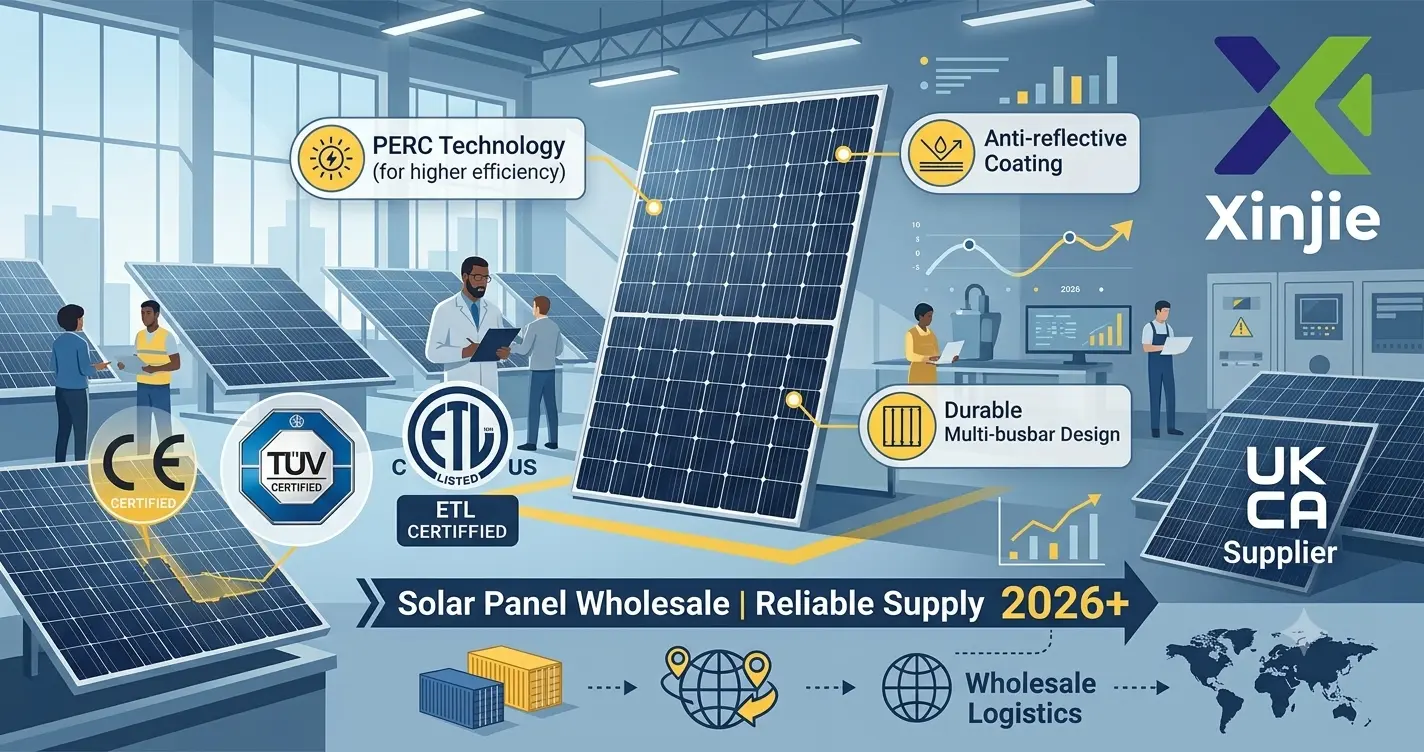
Last month I got an email from an importer in the Netherlands. He had already placed a deposit with another Chinese supplier, was two weeks from container loading, and had just discovered the panels carried no valid TUV certificate — only a self-printed "CE" sticker. The panels were technically blocked from his customer's roof because the project required proof of third-party conformity assessment. He lost the deposit. The deal collapsed.
That story is not unusual. In 2026, compliance pressure on solar importers has never been tighter. The EU, the UK, and North America each have distinct certification requirements, and walking into a procurement conversation without understanding them is how experienced buyers still get burned.
This article is for importers, EPC contractors, and wholesale buyers who need to clear compliance gates in Europe or the UK — and want to understand how Xinjie's PERC single-glass line is positioned to make that process straightforward rather than stressful.
📋 Table of Contents
1. Why Certification Is the Real Gatekeeper in 2026
When a buyer in Germany or the UK asks me for a "certified PERC panel," they usually mean one of three things: they need to satisfy a grid-connection requirement, meet a project-finance due-diligence checklist, or comply with an installer's professional liability insurance clause. In all three cases, the paper trail matters as much as the product itself.
Solar panels imported or manufactured in the European Union are subject to various regulations, directives, and standards — and ensuring compliance requires that the panels meet specific technical requirements, are correctly labelled, documented, and tested. That is not optional small print. That is the law.
Solar panels sold in the EU must carry CE marking, which requires compliance with IEC 61215 — performance testing for crystalline silicon panels — and IEC 61730 for safety qualification. A self-applied CE mark without third-party backing of those two standards is legally precarious for any importer because the liability sits with the party placing the goods on the EU market.
For buyers who also serve the UK market, a separate layer now applies. Before any solar module can be legally sold and installed in the United Kingdom, it must pass a dual certification system — the UKCA mark, which is a legal requirement for market access, and MCS certification, which is the key to commercial viability.
The short version: if your supplier cannot hand you original, verifiable, third-party certification documents before the container leaves port, you are carrying the compliance risk — not them.
2. CE Marking: What It Actually Requires for Solar Panels
CE is widely misunderstood. It is not a quality badge. It is a manufacturer's declaration of conformity with the applicable EU directives — primarily the Low Voltage Directive and the General Product Safety Regulation for solar panels. The problem is that a CE mark can be self-declared for some product categories, which means it can be printed without any external testing body ever seeing the product.
Manufacturers can self-declare CE compliance without third-party verification for many solar products — which is why buyers should always combine CE with additional certifications like TUV or IEC. This is advice I give to every new customer I speak to. A CE mark paired with a current TUV certificate is meaningful. A CE mark alone from an unknown supplier is a risk.
The underlying technical standards CE compliance points to are IEC 61215:2021 and IEC 61730. Panels certified to older standards may soon be outdated in some markets, affecting warranties and resale value. When you request CE documentation, always check the version of IEC standard the test was conducted against. An IEC 61215:2016 certificate on a panel sold in 2026 should prompt a follow-up question.
When procuring panels, verify that the model you are installing has current test certificates from an accredited test laboratory — certificates older than five years, or from non-accredited labs, should be checked against current panel versions, since manufacturers sometimes update manufacturing processes without updating certificates.
💡 Practical Take
Always ask your supplier for the specific IEC 61215 test report reference number and cross-check it against the issuing lab's online database. TUV Rheinland, TUV SUD, and Intertek all maintain searchable portals. If the certificate number does not resolve to a live record, treat it as unverified.
3. TUV Certification: The Third-Party Backstop Buyers Trust
TUV is the certification that serious procurement teams and project financiers look for first. Unlike self-declared CE marking, TUV certification requires a product to pass third-party testing conducted by an independent laboratory accredited by the TUV organization.
TUV certification subjects PV panels to 19+ rigorous tests based on IEC 61215:2021 standards — and crucially, TUV inspectors conduct ongoing factory audits beyond the initial certification, monitoring production quality continuously and verifying that every batch meets standards. That last point is what distinguishes TUV from a one-time test. The factory is audited regularly. Production consistency is part of what the certificate represents.
The tests themselves cover thermal cycling, damp heat exposure, mechanical load performance, hail impact resistance, and salt spray resistance — among many others. These are not arbitrary hurdles. They correspond directly to the environmental stresses panels face in real-world deployments across European climates, coastal installations, and high-altitude projects.
Xinjie's PERC single-glass panels carry certifications from both TUV Rheinland and TUV SUD — two independent arms of the TUV family. We also hold specific TUV certificates for dynamic mechanical load (wind pressure resistance), salt spray performance, and sand/dust resistance. When a buyer's project requires documentation for a specific mechanical or environmental stress test, we can provide it by product model rather than requiring them to chase generic statements.
4. UKCA: The Post-Brexit UK Gate That Catches Suppliers Off Guard
UKCA is the certification requirement that still trips up the most Chinese solar suppliers in 2026. Many still pitch their CE certificate as sufficient for the UK market. In some narrow circumstances that may currently be tolerated, but the direction of travel is unambiguous.
UKCA (UK Conformity Assessed) is the mandatory product marking for goods placed on the market in Great Britain — England, Wales, and Scotland — replacing the European CE mark after the UK's departure from the EU. The UKCA mark is a manufacturer's declaration that their solar module meets all relevant UK health, safety, and environmental protection legislation.
The UK continues recognizing CE marking beyond December 2024 alongside UKCA marking, giving businesses flexibility to use either marking for Great Britain market access. However, that flexibility is a transitional arrangement, not a permanent solution. Buyers building long-term supply chains for UK distribution need a supplier with UKCA in hand — not one who is waiting to see how the regulations evolve.
For UK residential installers specifically, the compliance chain goes further. A UK solar PV install needs an Electrical Installation Certificate to BS 7671:2018+A4:2026 covering the AC and DC work, an MCS certificate required for the customer to claim Smart Export Guarantee payments, a DNO notification, and a handover pack with commissioning results and warranties. The panel itself must be MCS-listed to be eligible for that installer workflow.
Xinjie holds a UKCA certificate for our PERC single-glass product line. We can supply the supporting Declaration of Conformity documentation for UK importers who need to complete their compliance file.
5. ETL Certification for North American Markets
North American buyers work under a different standard framework entirely. US markets typically require UL 61730 listing rather than CE marking. ETL certification, issued by Intertek, is a widely accepted alternative to UL listing — both are recognized by US and Canadian authorities having jurisdiction (AHJs) for solar installations.
ETL certification means the product has been tested by Intertek's accredited laboratories to the same UL 61730 / CSA standards that UL listing requires. For Canadian buyers, it also aligns with CSA requirements. For buyers serving both the EU and North American markets through the same supply chain, having both TUV/CE and ETL certificates from the same supplier eliminates the need to manage two separate panel SKUs from two separate suppliers.
Xinjie holds ETL certificates for both single-glass and dual-glass PERC variants. We also hold an Intertek Laboratory Certificate (and a second Intertek Laboratory Certificate for an additional product category) alongside our ETL listing. These are not marketing statements — they are document numbers we provide with every quotation to buyers who request them.
🔎 Pro Tip for Multi-Market Buyers
If you distribute into both the EU and the UK, request your supplier's CE certificate and UKCA certificate as separate documents, not a single combined declaration. Each has its own scope, issuing body reference, and applicable legislative basis. A combined document may not satisfy either jurisdiction's customs or project-finance auditors when reviewed carefully.
6. Xinjie's Full Certification Stack — What We Actually Hold
I will be direct here, because vague claims about "multiple certifications" are exactly what experienced procurement managers are tired of reading. Here is what Xinjie's PERC single-glass product line is certified to as of 2026:
CE — EU market access, Low Voltage Directive and GPSR compliant
TUV Rheinland — IEC 61215 & IEC 61730 performance and safety qualification
TUV SUD — additional independent TUV body certification
TUV Nord — including specific TUV Nord PV and monocrystalline TUV certificates
ETL (Intertek) — North America market access, UL 61730 equivalent
UKCA — Great Britain market access post-Brexit
CGC — China General Certification Centre, relevant for domestic and certain export markets
CNAS Laboratory Certificate — accredited testing lab recognition
Intertek Laboratory Certificate (two separate certificates covering different product scopes)
PID — Potential Induced Degradation resistance test certificate
Ammonia (NH3) — corrosion resistance for agricultural and high-humidity deployments
TUV Salt Spray Test — coastal and marine-adjacent installation qualification
TUV Sand & Dust — desert and arid climate installation qualification
TUV Dynamic Mechanical Load / Wind Pressure Resistance — structural certification for high-wind zones
Single Glass ETL — ETL specific to single-glass format
IAF TUV — International Accreditation Forum-recognized TUV accreditation
Beyond product certifications, Xinjie holds official authorized distributor status for JA Solar (2026), LONGi (Premium Strategic Partner), and Huawei Digital Power (Silver Distributor). We are also an Official Authorized Agent of SINENG Electric for 2025–2026. These authorizations matter to buyers because they confirm we source branded modules through legitimate supply chains — not grey-market channels — which is directly relevant to warranty validity and certification traceability.
👉 View Xinjie's full PERC Single-Glass product catalogue and available wattage options
7. Our PERC Single-Glass Line: Specs That Matter to Compliant Markets
PERC — Passivated Emitter and Rear Cell — remains the workhorse technology for residential and small commercial installations in compliant markets. While TOPCon and ABC modules attract most of the efficiency headlines in 2026, PERC single-glass panels occupy a distinct value position: proven long-term performance data, well-understood degradation rates, lower per-watt cost, and a certification track record that spans nearly a decade of rigorous real-world testing.
The monocrystalline PERC single-glass half-cell solar panel market is characterized by rapid growth and evolving technological landscape — with the 400–500W panel type currently the largest and most dominant segment, driven by its optimal balance of power output, size, and cost-effectiveness across residential, commercial, and public facility applications.
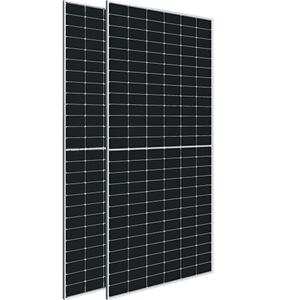
Xinjie's PERC single-glass line — sourced from our Hefei production base through certified manufacturing partners including JA Solar — is built around the following technical parameters relevant to compliance-focused buyers:
Half-cell monocrystalline silicon cells — reduces resistive losses and improves shade tolerance
Anti-reflective tempered glass front cover — passes TUV hail impact and mechanical load tests
PID-resistant cell treatment — confirmed by independent PID certificate
Ammonia and salt spray resistance — separately certified for agricultural and coastal projects
IP68-rated junction box standard across all models in this line
Linear power output warranty: ≤2% in year one, ≤0.55% per year thereafter (25-year performance)
Available wattage: 400W–545W range, with specific models confirmed to available stock
Every panel we ship is individually separated in packaging with cardboard corner protection to prevent edge-crack failures during ocean freight — a detail that sounds minor until you are processing an insurance claim on a container of cracked modules.
8. Certification Requirement Comparison: EU, UK, and North America
| Market / Requirement | EU (Incl. Germany, Netherlands, France) | UK (Great Britain) | North America (US / Canada) |
|---|---|---|---|
| Mandatory Product Mark | CE | UKCA (CE transitionally accepted) | UL 61730 or ETL equivalent |
| Underlying Performance Standard | IEC 61215:2021 | IEC 61215:2021 | IEC 61215:2021 / UL 61730 |
| Safety Standard | IEC 61730 | IEC 61730 | UL 61730 / CSA |
| Recommended 3rd-Party Cert | TUV (Rheinland / SUD / Nord) | TUV + MCS listing | ETL (Intertek) or UL listing |
| Import Duty (Panels) | 0% MFN (HS 8541.40, as of April 2026) | Subject to UK Global Tariff | Subject to Section 201 / AD/CVD measures |
| Xinjie Coverage | ✅ CE + TUV Rheinland/SUD/Nord | ✅ UKCA + CE transitional | ✅ ETL (Intertek) + Single Glass ETL |
Note: EU import duty information based on publicly available trade data as of April 2026. The EU has the clearest tariff position for solar developers — following the removal of anti-dumping measures on Chinese panels in August 2018, solar modules enter the EU at 0% MFN duty under HS 8541.40, and no new anti-dumping investigation has been initiated on solar panels as of April 2026. Always verify current duties with your freight forwarder before committing to a shipment.
9. Practical Sourcing Advice: How to Verify Certs Before You Pay a Deposit
Most buyers know they should check certifications. Fewer know exactly how to verify them rather than simply accepting a PDF from a supplier. Here is what I recommend to every importer I work with:
Request the certificate number, not just the certificate image. Every legitimate TUV, Intertek, and ETL certificate has a unique reference number. Cross-reference it against the issuing body's online portal.
Each certification body maintains online verification databases — check TUV at tuv.com, MCS at mcscertified.com, and UL at ul.com. Look for QR codes and unique ID numbers on certificates.
Check the scope of the certificate against your specific model. A certificate for "JA Solar JAM72D42 LB" does not automatically cover a different wattage variant unless that variant is listed within the certificate scope. Ask for the full product scope appendix.
Confirm the certificate is current. TUV certificates expire and require renewal. A certificate issued in 2020 for a product that has since undergone manufacturing process changes may no longer be valid as-issued.
Always verify directly through official portals, not supplier-provided documents alone.
For EU projects: request the Declaration of Conformity (DoC) alongside the CE mark. The DoC lists the specific directives and standards the product is declared compliant with. Without it, CE marking is an incomplete compliance file.
For UK projects: request UKCA DoC separately. As noted earlier, a combined CE/UKCA declaration can be ambiguous — get the UK-specific document.
Ask about factory audit frequency. For TUV-certified products, ask when the most recent factory surveillance audit was conducted.
TUV inspectors conduct ongoing factory audits beyond initial certification, monitoring production quality continuously and verifying every batch meets standards. A supplier who cannot tell you the last audit date is a yellow flag.
At Xinjie, we include certificate documentation in every formal quotation. You do not need to chase it separately. If a specific test certificate is required for a project tender — for example, a separate TUV salt spray test certificate for a coastal installation — we can pull that document by product model.
👉 Request a full certification document package for Xinjie's PERC Single-Glass product line
10. FAQ: CE TUV Certified PERC Solar Panel Wholesale
Q: Does a CE mark alone satisfy EU import requirements for solar panels?
Technically, CE marking is the mandatory market access requirement. However, because CE can be self-declared for some solar product categories, serious buyers and project owners always require TUV or other accredited third-party certification as supporting evidence. A self-declared CE without third-party testing backing is a compliance liability, not an asset.
Q: Is UKCA the same as CE for the UK market?
No. UKCA is the UK's post-Brexit equivalent of CE marking for Great Britain — England, Wales, and Scotland. It is a separate legal declaration under UK legislation. CE marking is currently accepted transitionally in the UK, but buyers building durable supply chains for UK distribution should source UKCA-certified product now rather than rely on transitional provisions that may change.
Q: What is the difference between TUV Rheinland, TUV SUD, and TUV Nord certifications?
TUV Rheinland, TUV SUD, and TUV Nord are three separate and independent certification bodies that all operate under the broader TUV (Technischer Überwachungsverein) umbrella in Germany. Each conducts independent testing and issues its own certificates. Holding certifications from more than one TUV body does not mean "double certifying" the same thing — different buyers and projects sometimes specify different TUV bodies. Xinjie holds certificates from all three.
Q: Can I use ETL-certified panels in both the US and Canada?
Generally yes — ETL certification issued by Intertek is recognized by authorities having jurisdiction (AHJs) in both the US and Canada, as it tests to the same UL 61730 and CSA standards. You should still confirm acceptance with your specific project's AHJ, as local requirements can vary by state, province, and utility interconnection agreement.
Q: Does Xinjie ship PERC single-glass panels to Europe with full documentation?
Yes. Every shipment includes a commercial invoice, packing list, bill of lading, CE Declaration of Conformity, relevant TUV certificates, and — for UK-destined goods — UKCA documentation. For project-specific requirements such as salt spray or ammonia test certificates, we provide those by product model on request. We ship within 7 days of order confirmation and accept TT payment.
Q: What wattage range is available for Xinjie's PERC single-glass panels?
Our PERC single-glass line covers 400W through 545W in monocrystalline half-cell format. Specific wattage availability depends on current production schedules. Contact us with your project volume and delivery timeline and we will confirm available stock and lead times within one business day.
Q: Are you a manufacturer or trading company?
Xinjie operates its own production lines in Hefei, Anhui Province, with sales operations based in Wuhan. We are an official authorized distributor and strategic partner for JA Solar, LONGi, and Huawei Digital Power, meaning our branded modules are sourced directly through authorized channels with full warranty validity. We welcome third-party factory inspections — you are most welcome to visit our Hefei facility.
Ready to Source CE & TUV Certified PERC Solar Panels?
Xinjie's Mr. Xiao will respond within one business day — with cert documents included in the first reply.
📞 +86-19072080183 | 📠 027 86521066 | 📍 Shun'an Building, Tuanjie Avenue, Wuhan, Hubei
Mr. Xiao — International Sales Director
Hubei Xinjie New Energy Technology Co., Ltd. | Est. 2017 | Wuhan HQ + Hefei Production
Mr. Xiao leads Xinjie's international business development across Europe, the UK, North America, the Middle East, and Southeast Asia. With over 15 years in the PV supply chain — spanning module sourcing, certification compliance, logistics, and system integration — he writes directly from the field experience of helping importers navigate real procurement challenges, not theoretical ones. He can be reached at xinjie@hbxjenergy.com.
References
ComplianceGate — Solar Panel Regulations in the European Union: An Overview (2025) — compliancegate.com
SurgePV — Europe Solar Compliance 2026: EU Regulations & National Laws (March 2026) — surgepv.com
SurgePV — Solar Panel Import Duty Rates by Country 2026 (May 2026) — surgepv.com
PVKnowhow — UKCA & MCS Certification: Guide for UK Solar Manufacturers (May 2026) — pvknowhow.com
CoulEnergy — Solar Panel Procurement: Essential Certifications That Matter (September 2025) — couleenergy.com
CoulEnergy — Understanding Solar Panel Certification: IEC 61215 & 61730 Standards Explained (July 2025) — couleenergy.com
Elec-Mate — Solar PV Certificate Requirements: MCS UK Guide (May 2026) — elec-mate.com
MarketReportAnalytics — Monocrystalline PERC Single Glass Half Cell Solar Panel Market Report 2026–2034 (February 2026)
IEC 61215:2021 — Terrestrial Photovoltaic (PV) Modules: Design Qualification and Type Approval
IEC 61730:2023 — Photovoltaic (PV) Module Safety Qualification